



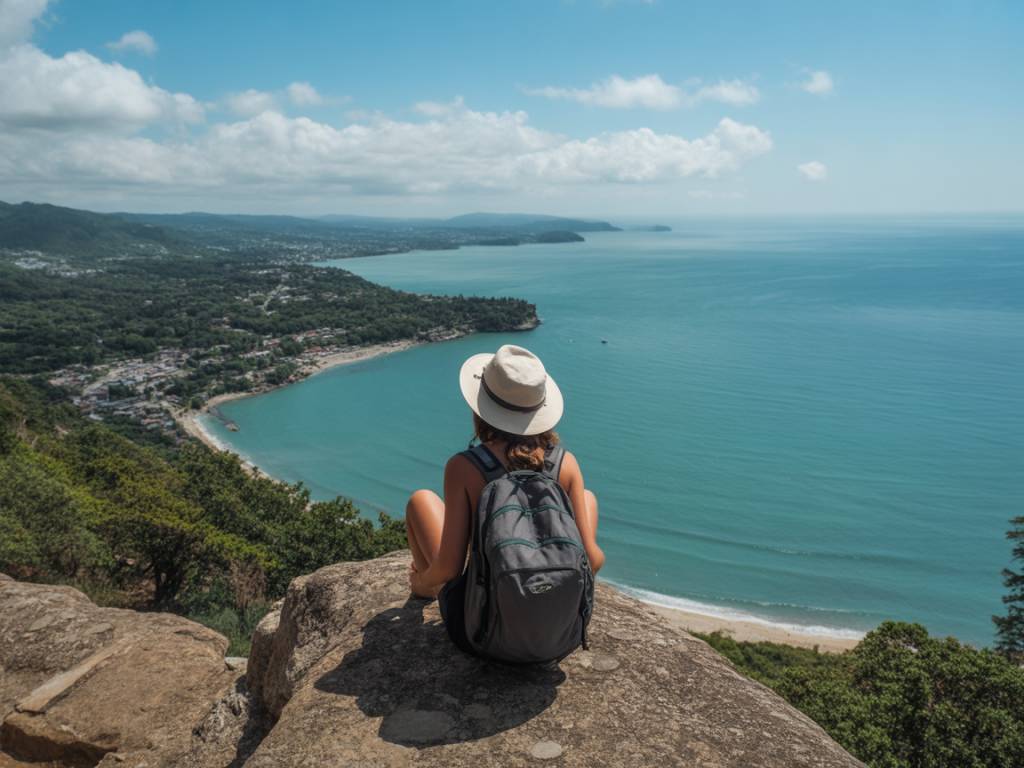
Six months. It sounds both endless and impossibly short, doesn’t it? Long enough for a new language to start rolling off your tongue. Long enough for your favourite pair of shoes to give up on you somewhere between a Thai night market and a Portuguese cobblestone street. Long enough, especially, to feel your life gently shift on its axis.
When I left for my first six-month trip, I thought I was prepared. I had spreadsheets, packing cubes, a budget app and a romanticised vision of myself journaling in sunlit cafés from Hanoi to Lisbon. Reality, of course, was messier — and much richer. This is the guide I wish I’d had before zipping up my backpack that very first morning.
Why six months can change everything
There’s something magical about the half-year mark. It sits in a sweet spot between holiday and expatriation — you’re away long enough to slip into local rhythms, but not so long that home becomes a distant memory.
In the first few weeks, you visit. By the third month, you live. You know where the good coffee is, which stall in the market gives an extra handful of herbs, the precise stretch of beach where the evening light turns the sea into liquid silver.
Six months allow for:
- Slow mistakes: You have time to take the wrong train in Italy, laugh about it, and still explore that little town you’d never planned to see.
- Unexpected detours: A dinner with strangers turns into a week in the mountains. A cancelled ferry becomes three unplanned days in a fishing village.
- Real rest: You can take days off from “doing” and simply be somewhere, without guilt nibbling at your heels.
The trip stops being a checklist of sights and turns into a series of lived-in days. That’s where the transformation hides: in the ordinary moments you never imagined when you booked your first flight.
Designing your route without losing your mind (or your soul)
Before you dive into flight comparators and colour-coded maps, take a breath. The biggest mistake I made with my first long trip was trying to squeeze an entire atlas into six months. Spoiler: you can’t.
Instead of asking “Where can I go?”, ask:
- What do I want to feel? Do you dream of humid nights and noodle stalls? Stormy Atlantic coasts? The dry quiet of a Moroccan desert camp?
- How much time do I want to spend on the move? Be honest. Overnight buses and back-to-back flights sound exciting… until week four.
- How important is budget? Six months in Scandinavia is not the same as six months in Southeast Asia or rural France.
A simple rule I now swear by: one major region per six-month trip. For example:
- Asia focus: Thailand, Laos, Vietnam, Cambodia — with perhaps a soft landing in Japan or South Korea at the end.
- Europe focus: Portugal, Spain, France, Italy, maybe a slower loop with a month in one countryside area.
- Africa & Europe mix: Morocco, a hop to Spain, then France, blending cultures without changing continents every other week.
Anchor your trip with a few “home bases” where you’ll stay longer — two to four weeks in one place. A seaside town in Portugal, an old neighbourhood in Hanoi, a riad in Marrakech. From there, you can explore nearby spots without constantly packing and unpacking your life.
Budgeting for six months of freedom (and the surprises)
Money talk may not be poetic, but nothing kills the romance of a trip faster than daily anxiety about your bank balance.
Start with three layers:
- Monthly cost of living: Accommodation, food, local transport, SIM cards, occasional tours or entry fees.
- Fixed big costs: Long-haul flights, travel insurance, visas, vaccinations, initial gear.
- Safety net: This is not optional. Aim for at least one extra month of average expenses tucked away.
To estimate a daily budget, research by country. For example:
- Southeast Asia (Thailand, Vietnam, Laos): backpacker style from £20–40/day, more if you love cafés, private rooms and the occasional splurge.
- Southern Europe (Portugal, Spain, France coastal areas): more realistically £40–80/day, depending on season and comfort level.
- North Africa (Morocco, Tunisia): often in the £25–50/day range, again depending on choices.
One trick that genuinely changed my trips: set a “soft” daily budget, and a weekly one. Some days you’ll spend almost nothing, picnicking by a river in France with market bread and cheese. Other days, you’ll say yes to a wine tasting, a long train ride, or a dive trip. The weekly view evens it all out.
And beware of the sneaky extras: laundry, replacing worn-out shoes, postage for that heavy box of treasures you couldn’t resist in a Moroccan souk, extra luggage fees when your backpack mysteriously gains weight.
Packing: what six months on the road really needs
I once started a six-month journey with three pairs of jeans. Three. Somewhere between Bangkok and Bordeaux, I learned my lesson: less fabric, more versatility.
The secret is to think in layers and contexts, not outfits. Ask yourself: “Could I wear this in two different climates and three different situations?” If the answer is no, it probably stays home.
Consider:
- The essentials: 7–10 days of underwear, 2–3 light tops, 1–2 warmer layers, 1 rain jacket, 1 pair of good walking shoes, 1 pair of sandals, 1 simple outfit that makes you feel lovely for a nicer dinner.
- Climate flexibility: A thin merino layer is worth its weight in gold, from chilly Paris mornings to overnight buses in Vietnam.
- Health kit: Basic medication you know works for you, plus plasters, rehydration salts, and anything you need regularly at home.
- Digital tools: A lightweight laptop or tablet if you plan to work, backup photos on a drive or in the cloud, and offline map apps.
Think of your bag as a tiny, travelling home. Every item takes up physical and mental space. Will that fifth t-shirt bring you as much joy as having room to tuck in a small ceramic bowl from a village in central France or a handwoven scarf from Laos?
Allow a little space for the objects that will become your story.
Finding your rhythm: between wonder and weariness
Six months is a marathon, not a sprint. The first time, I approached it like a child let loose in a sweet shop: saying yes to everything, visiting every attraction, filling every day. By month two, I was quietly exhausted, sitting in a café in Lyon, staring at my coffee as if it might answer some bigger question.
What I wish I’d known: it’s normal for the initial blaze of excitement to soften into something gentler. The key is to create your own travel rhythm.
Ask yourself:
- Do I prefer to move every few days, or settle for weeks?
- Do I feel more alive in cities, coasts, or quiet countryside?
- When do I need alone time, and when do I crave company?
Experiment. Spend one month moving quickly, another moving slowly. Try a few days in a hostel dorm in Lisbon, then a quiet guesthouse in rural Asia where the morning soundtrack is roosters and distant mopeds. Notice when you feel most like yourself.
Build in non-travel days. Days where your biggest adventure is finding the best croissant on your street in Paris or watching the light change on rice paddies in northern Vietnam.
Those “ordinary” days are where your mind catches up with your feet.
Staying safe without living in fear
Most of the world is far kinder than the news suggests. But six months is long enough for a few tricky moments — missed buses after dark, confusing border crossings, a bad feeling about a street you’ve turned onto.
You don’t need to be paranoid; you do need to be prepared.
- Copies and backups: Photos of your passport, visas and insurance stored in the cloud and on your phone.
- Basic street smarts: Trust that small voice when it says “this doesn’t feel right.” You can always walk away.
- Health boundaries: Don’t be the hero who eats dubious street food on day one then spends week one in bed. Start gently.
- Arrival strategy: Always know how you’re getting from the airport or station to your first accommodation, especially at night.
Safety also has a softer side: having someone back home who knows roughly where you are, checking in occasionally, sharing your general itinerary. Not because you owe anyone a play-by-play, but because having an anchor can make the world feel a little more navigable.
Loneliness, friendships and the art of saying goodbye
No one told me how many people I’d meet — and leave — in six months. Travel friendships are intense, compressed into days that feel like weeks. You share sleeper trains, sunrise hikes, unexpected tears over wine in a tiny French bar, and then… you part ways.
There will be evenings where loneliness sits beside you at dinner. You’ll watch groups of friends laughing and wonder what your own friends are doing at home. That’s normal. You’ve stepped out of your usual frame; there’s an echo before the new one fills.
What helps:
- Light rituals to feel connected: A weekly call home, sending a photo of “today’s view” to a close friend, writing postcards from cafés.
- Joining existing communities: Walking tours, cooking classes, co-working spaces, language exchanges. These are the shortcuts to conversations.
- Accepting fleeting connections: Not every new friend is for life. Some are just for that one stormy evening in Marseille or that trek in northern Thailand — and that’s beautiful too.
Six months teach you to hold people gently: grateful for the chapter you share, at peace when pages turn.
Working on the road (without losing the joy of travel)
If your six months involve remote work, the fantasy of answering emails from a hammock dissolves quickly the first time your video call cuts off in the middle of a Moroccan windstorm.
It is possible to blend work and travel, but it requires intention.
Think in work blocks and travel blocks. For example:
- Two weeks settled in one city with good Wi-Fi and cafés (Lisbon, Chiang Mai, Bordeaux), working regular hours.
- Followed by one or two weeks with lighter work and more movement, using offline-friendly tasks during long train or bus rides.
Choose accommodation with a clear workspace: a table by a window, a quiet corner. When you finish for the day, step outside immediately — let the place you travelled all this way to reach greet you, even if it’s just a golden half-hour walk along the river.
And set boundaries. If you try to be a full-time traveller and a full-time worker, something — your health, your joy, or your Wi-Fi — will eventually fray.
Staying connected… and learning to disconnect
Your phone will be your map, your camera, your translator, your emergency contact. It’s a small miracle of modern travel. It’s also very good at pulling you out of the present moment and back into the constant scroll of elsewhere.
Balance is everything.
- Local SIM cards: Often cheaper and more reliable than roaming. Buy them at official shops when you arrive.
- Offline tools: Download maps, translation packs and playlists for long stretches without signal — trains across France, buses through rural Laos, ferries between islands.
- Phone-free pockets of time: A morning walk without headphones, dinner where the phone stays in your bag, a beach afternoon where your only notification is the tide creeping closer.
Some of my clearest memories are from moments when I simply didn’t have Wi-Fi: watching the sky darken over a rice field, listening to strangers argue affectionately about football in a bar in Marseille, getting lost in a maze of alleyways in Fez and trusting my feet to find their way out.
Coming home as a slightly different person
No one warned me about the last flight — the one that brings you back. In your mind, coming home is supposed to be the easy part. Familial hugs, familiar streets, your own pillow. And yes, there is sweetness. There’s also a strange disorientation, as if you’ve slipped into clothes that almost fit but not quite.
In six months, you’ve gathered a quiet collection of new selves: the one who can negotiate in another language, the one who navigates foreign metro lines with ease, the one who knows she loves early mornings by the sea or late nights in old city squares.
Give yourself time to integrate those selves instead of rushing back into your old pace as if nothing happened.
- Keep a few small rituals from your trip: a slow Sunday breakfast like in that tiny French café, a weekly walk at sunset, a spice-laden dish you learned to cook in Asia.
- Sort your photos slowly. Let each one pull you back for a moment — the smell of cardamom, the echo of church bells, the way the air felt stepping off that overnight train.
- Stay in touch with the people you genuinely connected with, even just occasionally. They were witnesses to a version of you that bloomed far from home.
Most of all, remember that a six-month journey isn’t an escape from your life. It’s an extension of it. The courage, curiosity and softness you cultivated on the road don’t vanish when you unpack your backpack; they’re threads you can weave into whatever comes next.
If you’re standing on the edge of this kind of adventure now — hesitating between excitement and fear — know this: you will never feel perfectly ready. Pack as thoughtfully as you can, leave space for the unexpected, and step through the departure gate anyway.
The world has a way of meeting you halfway when you decide to go.