



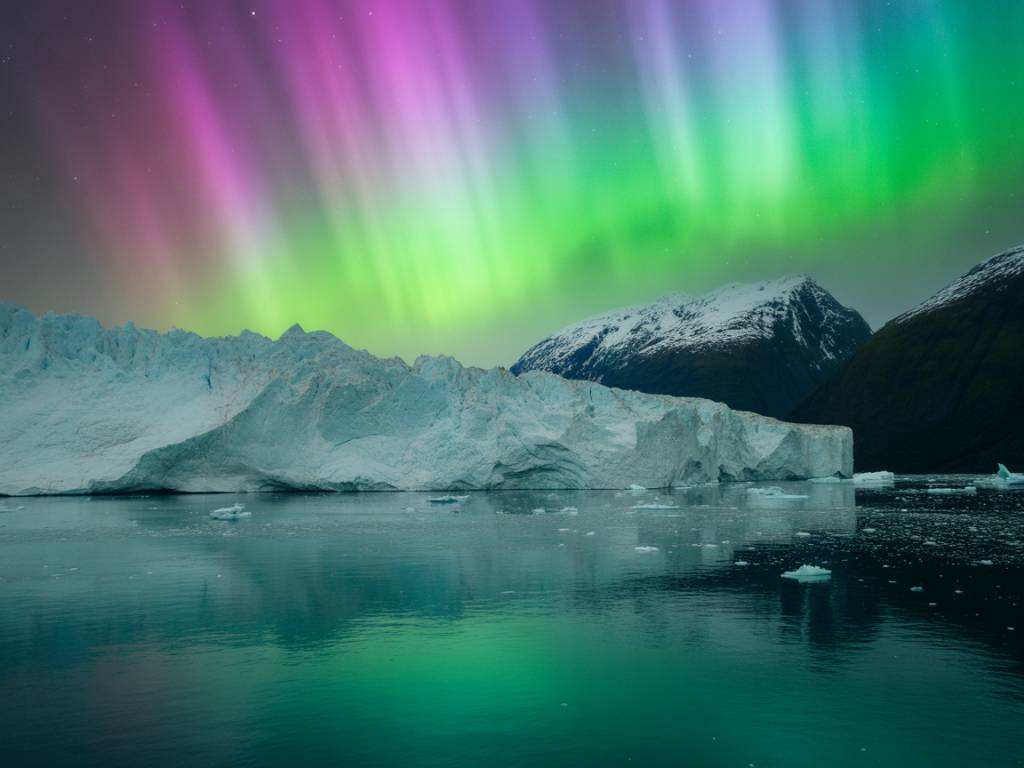
There are journeys that feel less like holidays and more like crossings — passages to the very rim of what we know. Alaska was that for me: a place where the maps seem to fray at the edges, where the world becomes ice and mist and green light, and you realise how small you are in the best possible way.
If you’re dreaming of glaciers that creak and groan like living beasts, whales surfacing in silver water, and northern lights dancing silently above a sleeping town, Alaska might already be calling you. Let me take you there.
When to go to Alaska for glaciers, whales and northern lights
Alaska stretches across such an immense territory that “when to go” is always a compromise between what you want to see and how much cold you’re willing to embrace.
For this trifecta — glaciers, whales and auroras — here’s how the seasons tend to play out:
- Late May to early September: Best for glaciers and whales. Long days, most tours running, milder temperatures, lush landscapes.
- June to August: Peak whale season in many coastal areas (especially June–July).
- Mid-August to late March: Best window for northern lights, particularly around Fairbanks and the interior, when nights are finally dark again.
If you want all three in a single trip, aim for late August or early September. You’ll still find glacier cruises and whale-watching tours operating along the coast, and the nights are dark enough inland to give you a real chance of seeing the aurora.
This is exactly when I travelled: a transitional season when summer’s softness meets autumn’s sharp light, and the tundra blushes with red and gold.
First impressions: landing at the edge of the world
Flying into Anchorage, I pressed my forehead against the window like a child. Below, the mountains looked almost theatrical, as if someone had sketched them with exaggerated strokes: rocky spines powdered with early snow, valleys carved by ice, a coastline riddled with inlets where the sea pushed its way into the land.
The air that greeted me outside the airport was different — cleaner, yes, but also denser somehow. It smelled of spruce and cold metal, like breathing in a glacier from a distance.
Even in the city, the wilderness feels close. You can be eating a bowl of clam chowder one moment, and less than an hour later stand on a muddy trail, bear bell chiming softly on your backpack, with the hum of traffic already forgotten. This proximity — civilisation and the wild separated only by a few minutes and a thin thread of asphalt — sets the tone for everything that follows.
Meeting the giants of ice: chasing Alaska’s glaciers
Glaciers are the slow heartbeats of Alaska. They move, but at a pace that mocks our busy little lives, cracking and groaning on scales of time we rarely consider. Seeing one up close is a powerful reminder that the Earth is not static; it is always shifting beneath us.
You can meet these giants in several ways, depending on how adventurous (and budget-flexible) you’re feeling.
1. Glacier cruises in the fjords
I joined a day cruise from Seward into Kenai Fjords National Park, a place where mountains collapse directly into the sea, and hanging glaciers cling to dark rock like frozen waterfalls. The boat left early, the harbour still sleepy, gulls circling above us like impatient escorts.
Within an hour, the town had disappeared behind rocky headlands and the colour of the water had changed to a milky turquoise — that particular hue born from rock flour, the fine sediment carved by ice and carried by glacial melt.
And then, the glacier itself: Aialik Glacier, a wall of blue ice towering at the end of the fjord.
The captain cut the engine and suddenly there was only silence and the occasional soft crack of ice settling. Or so I thought. A few minutes later, the sound came — a deep, booming roar, followed by a splash as a block of ice the size of a house crashed into the bay.
“White thunder,” our guide whispered.
We all stood outside, faces stung by the cold wind, cameras forgotten. Watching a glacier calve is both exhilarating and slightly unsettling, like witnessing something you were never really meant to see.
2. Walking on the ice
If you want to feel the glacier under your boots, places like Matanuska Glacier (a few hours from Anchorage) offer guided hikes right onto the ice. Spikes on your feet, helmet on your head, you follow your guide through a maze of frozen waves and deep blue crevasses.
On Matanuska, I remember pausing beside a narrow moulin — a vertical shaft where meltwater disappears into the glacier’s interior. Peering down, I could hear the water rushing far below, echoing through the ice. It felt like putting your ear to the chest of a sleeping giant.
3. A helicopter view (if you can)
Helicopter tours are undeniably expensive, but if your budget allows, they offer a different kind of intimacy with the landscape. From above, the glaciers look like rivers frozen mid-flow, their surfaces cracked and striated, their tongues stretching towards the valleys.
Hovering over a glacier field near Juneau, I had that strange, almost vertigo-inducing sensation of witnessing something too vast to fully grasp. It’s humbling in the best way.
Whales on the horizon: life in the cold sea
Alaska’s waters are just as alive as its mountains. In summer, plankton blooms turn the sea into a banquet, and the whales arrive — sometimes in such numbers that you start to recognise individual blows on the horizon.
Where to go whale watching
- Juneau & the Inside Passage: Famous for humpback whales and the dramatic “bubble-net feeding” behaviour, where they hunt cooperatively.
- Seward & Resurrection Bay: Great for humpbacks, orcas, and other marine wildlife like sea otters and puffins.
- Prince William Sound: A quieter, more sheltered maze of islands and fjords with good whale and porpoise sightings.
I went out from Seward, under a sky that couldn’t quite make up its mind between sun and rain. The sea, at least, seemed perfectly content — a calm slate-grey surface dotted with the odd floating puffin, like little clowns on the water.
The first whale announced itself with a blow: a quick exhalation that rose in a pale mist above the surface. The boat slowed, and for a while we saw nothing more. Just the dimpling of the sea, a tail flash in the distance, as if the whales were testing our patience.
And then, as the captain gently repositioned us, a humpback surfaced close enough that we could see the barnacles on its back. The sound of its breath — that explosive huff — was far more moving than I expected. So physical, so vulnerable, for such a giant creature.
We watched in silence as it dove, tail lifting gracefully out of the water, droplets falling in slow motion. The captain turned off the commentary. No music, no chatter. Just us, the sea, and the occasional hiss of rain on our jackets.
Later, we saw a group of orcas, black fins slicing the surface like punctuation marks. They moved with a precision that felt almost choreographed, a fluid, effortless power.
Whale watching with respect
Most reputable operators in Alaska follow strict guidelines to limit disturbance to marine life. When choosing a tour, look for:
- Companies that keep a generous distance from the animals.
- Naturalist guides who talk about behaviour and conservation, not just “getting the shot.”
- Smaller boats, which are often quieter and less intrusive.
Remember you’re a guest in their home. Sometimes the whales will come close. Sometimes they won’t. That unpredictability is part of the privilege.
Waiting for the sky to dance: chasing the northern lights
Seeing the aurora borealis is not like booking a show. It’s more like being invited to a performance that may or may not happen, and never according to your schedule. You wait, you shiver, you check the sky again. And when it does appear, it feels like a gift.
Where to go for auroras in Alaska
- Fairbanks & the Interior: One of the best places on Earth for consistent northern lights activity from late August to April.
- Remote lodges: Around the Chena River, the Dalton Highway, or the Brooks Range, where light pollution is minimal.
- Even from Anchorage & Denali: You can sometimes see auroras if the conditions are strong and the skies are clear.
I based myself near Fairbanks, in a simple wooden cabin with big windows and a heater that clicked reassuringly through the night. During the day, the forest smelled of damp earth and spruce; at night, it became a black silhouette against the stars.
The first two nights, the aurora forecast taunted us with promising numbers, but clouds had other plans. We sipped hot chocolate on the porch, watched a faint green haze struggle behind the clouds, and eventually headed to bed with cold toes and hopeful hearts.
On the third night, the sky cleared.
It started as a pale arc low in the north, almost easy to miss. A soft wash of green, like someone had dusted the sky with chalk. Gradually, it brightened, stretching from one side of the horizon to the other.
Then, as if a switch had been flipped, the arc unravelled. Curtains of light cascaded upwards, twisting and folding in on themselves. Streaks of purple flashed at the edges, subtle and fleeting.
What surprised me most was the movement. Photographs always make auroras seem static, but in reality they flicker, shimmy, ripple. They have a tempo, a rhythm. Sometimes they just hover quietly; sometimes they swirl so dramatically you almost feel dizzy watching them.
We stood there in the snow, necks craned back, barely speaking. The cold bit my fingers, but I don’t remember caring. There are moments that stamp themselves so deeply into your memory that discomfort becomes irrelevant. This was one of them.
Practical tips for aurora hunting
- Stay several nights: Give yourself at least 3–4 nights in a good aurora region to increase your chances.
- Check forecasts: Websites and apps can indicate aurora activity and cloud cover, but take them as hints, not promises.
- Dress seriously warm: Layers, hand warmers, proper boots. Standing outside at night is much colder than daytime hiking.
- Bring a tripod: For photos, you’ll need long exposures. But don’t spend the whole night staring at your camera screen — look up.
Small towns, big feelings: life along Alaska’s roads and harbours
Between glaciers and auroras, life in Alaska happens in the in-between: along winding highways, in harbours scented with diesel and salt, in diners where coffee is strong and conversations unhurried.
On the drive from Anchorage to Seward, I stopped in Moose Pass, a tiny community wrapped in mist the morning I arrived. The local café served cinnamon rolls so large they needed two hands, and the woman behind the counter called everyone “hun” in a way that felt perfectly unforced.
Later, in Seward, I watched a fisherman clean his catch on the dock while ravens waited nearby, pretending not to care but ready to pounce on every scrap. He chatted about the weather, the salmon run, and the way winters had been changing, each anecdote stitched with an easy pragmatism that felt distinctly Alaskan.
Everyone seems to have a story of bears on porches, moose traffic jams, or winter nights when the power went out and the stars felt almost too close. There is a rugged pride here, but also a softness — a quiet respect for the land that can both sustain and endanger you.
One evening, in a small bar in Fairbanks, I listened to an Elder from a nearby Indigenous community talk about the aurora. For him, these lights were not a “bucket list experience,” but part of a living, breathing world of stories and beliefs. I won’t repeat his words here — some tales feel like they belong to the place itself — but it reminded me to approach Alaska not as a backdrop for my adventures, but as a home to many peoples and cultures.
Practical tips for planning your own Alaska adventure
Alaska rewards spontaneity, but a bit of planning will make your trip smoother and more sustainable.
- Choose your base points wisely:
- Anchorage: Good hub for road trips to Seward, Whittier, Matanuska, and Denali.
- Juneau: Ideal for glacier viewing and whale watching in the Inside Passage.
- Fairbanks: Best for northern lights and interior landscapes.
- Combine coast and interior: For glaciers and whales, plan time along the coast; for auroras, add a few nights inland.
- Rent a car if you can: Distances are long, but the roads are often scenic and surprisingly manageable in summer and early autumn.
- Pack for all seasons: Layers are essential. Even in August, I wore a down jacket on the boat and a wool hat under the auroras.
- Book key activities early: Glacier cruises, whale-watching tours and some remote lodges fill up quickly in high season.
- Travel lightly on the land: Stick to marked trails, support local businesses, minimise waste. In a place this wild, your footprint matters.
Perhaps the most important tip: leave space in your itinerary. Some of my favourite moments in Alaska were unplanned — a detour to a gravel beach, watching salmon fight their way upstream; a roadside viewpoint that turned into an hour of staring at a valley brushed with mist.
Why Alaska lingers long after you’ve left
Back home, when I close my eyes and think of Alaska, certain images surface before all others.
A glacier glowing blue under a low grey sky. The echo of “white thunder” rolling across a quiet fjord.
The exhale of a humpback, heavy and intimate in the stillness of the bay.
A sky turning green at the edges, then unraveling in shimmering curtains overhead while the snow crunches under my boots.
But beyond the obvious spectacles, it’s the quieter sensations that remain: the weight of a wool hat pulled down over wind-tangled hair; the smell of spruce and wet soil; the way strangers share tips about good viewpoints as if you’re already part of some loose, itinerant family.
Alaska feels, in many ways, like a test of your ability to pay attention. The drama is there — mountains, whales, northern lights — but the soul of the place lives in the details: a raven calling from a power line at dusk, the pink tint on icy peaks at sunrise, the way fog lifts slowly off a lake to reveal a perfect reflection.
If you go, go with open eyes and a willingness to stand still. Let the glaciers remind you of time on a grander scale. Let the whales show you how much life pulses beneath the surface. Let the northern lights teach you patience — and the joy of being, just once, in the right place at the right time, under a sky that has decided to dance just for you.