


Why Albania stole my traveller’s heart
I landed in Tirana with no expectations and a one-way ticket from London. A few friends had whispered that Albania was “like Croatia fifteen years ago”, all wild beaches, cheap cafés and mountains where time seemed to idle. What I found was far richer: a country at the edge of Europe, stitched together by forgotten castles, turquoise bays and alpine pastures that smelt of wild thyme.
This is the story of my road trip across Albania — from the UK to pristine beaches, dramatic Alps and sleepy stone towns — and a practical guide if you’re dreaming about booking an Albania tour from the UK yourself.
Getting from the UK to Albania: the easy part
Despite how remote it feels on arrival, Albania is surprisingly accessible from the UK.
I flew from London Gatwick to Tirana with a short stopover in Europe. Most routes connect via cities like Rome, Vienna or Istanbul. Total travel time: around five to six hours in the air, plus a little airport limbo.
Other options from the UK:
- Direct seasonal flights: In summer, some airlines offer direct connections from London to Tirana. They disappear like swallows in autumn, so check dates early.
- Fly to Corfu, ferry to Sarandë: A favourite for beach-lovers. Fly from the UK to Corfu, then take the ferry (around 30–70 minutes) across to Sarandë in southern Albania. Suddenly you’re on the Albanian Riviera without crossing Tirana at all.
- Overland by car: If you’re tempted by a big European drive, you can ferry from the UK to France, then drive through Italy and hop on a ferry from Bari or Brindisi across the Adriatic to Durrës or Vlorë. It’s a journey in itself, perfect if you like stringing countries together like beads on a necklace.
Once in Albania, the real adventure starts with a rental car. I picked mine up at Tirana airport: tiny, white, and slightly suspicious in the clutch, but it never failed me.
First impressions of Tirana: colour, coffee and chaos
Tirana greeted me with heat shimmering on concrete, a chorus of car horns and the smoky aroma of grilling meat drifting from tiny eateries. It is a city that hums rather than poses. Brightly painted buildings, tangled electric cables, and unexpected pockets of calm.
Before hitting the road, I spent a day settling into Albania’s rhythm:
- Skanderbeg Square: Vast and open, edged by the National History Museum and the Et’hem Bey Mosque. Children chased pigeons across the marble while old men watched, hands folded behind their backs.
- Block area (Blloku): Once reserved for the communist elite, now a hub of cafés and bars. I lingered over an espresso so strong it made my fingers tremble, watching locals glide by in linen shirts and sunglasses.
- New Bazaar (Pazari i Ri): Piles of glossy peppers, heaps of cherries, soft mounds of cheese, and the bright scent of oranges in the air. The stallholder pressed a fig into my palm with a smile and a single word of English: “Welcome.”
Tirana is not the main event of an Albania trip, but it sets the tone: generous, unpolished, full of small surprises.
Southbound to the Albanian Riviera: where the mountains meet the sea
From Tirana, I pointed the car south, towards the coast. The road curled through olive groves and sleepy towns where cafés spilled onto pavements, chairs always turned towards the street, as if the whole country were watching life go by.
My goal was the Albanian Riviera, a stretch of Ionian coast that blends Greek-blue sea with a fraction of the crowds.
The Llogara Pass: the moment everything tilts
The real spell began at the Llogara Pass. The road wound up into a forest of pines, trunks straight and tall, the air suddenly crisp and resinous. I pulled into a small lay-by when the trees thinned, stepped out into a silence broken only by the wind and distant cowbells.
Below me, the Adriatic laid itself out like a sheet of polished glass. Pale turquoise near the shore, deepening to ink-blue further out. The coastline folded and unfolded in hidden bays and rocky fingers. On a clear day, you can just make out Corfu like a faint shadow on the horizon.
It was the sort of view that makes you forget you have somewhere to be.
Himarë & the quiet rhythm of the coast
I based myself in Himarë, a small seaside town that still feels more like a village than a resort. In the evenings, families emerged for a gentle promenade along the seafront, gelato in hand, teenagers posing for photos in the soft light, grandparents sitting in pairs on benches, trading stories.
Days melted into a simple routine:
- Morning swims at Livadhi Beach: Arriving early, I often had the pebble shore almost to myself. The water was cold enough to startle but clear as glass. Tiny fish flickered around my ankles, just curious enough to be seen.
- Lunch in a taverna: Plates of grilled fish, lemon wedges still beaded with juice, salads glossy with local olive oil. The tomatoes tasted of sun.
- Afternoons exploring coves: Jale, Gjipe and Porto Palermo all within easy reach by car. Some required a short hike; all rewarded with quiet corners of sea and rock where time seemed to slow.
Gjipe Beach: a hidden cove between cliffs
Of all the beaches, Gjipe stayed with me the most. To reach it, I left the car at the end of a dusty, unassuming road and followed a path skirting a canyon. The air smelt of warm earth and dry herbs crushed underfoot. Lizards skittered across sun-baked stones.
Then, suddenly: the beach. A narrow crescent of pale sand hemmed in by steep limestone walls. The sea glowed a soft, impossible turquoise. No big hotels, only a couple of simple beach bars, sunbeds scattered rather than regimented.
I spent a long afternoon there, moving only between sea and shade. When I finally walked back to the car, my skin tasted of salt and my hair held the faint scent of smoke from a far-off barbecue.
From sea to stone: Gjirokastër and the echo of history
Leaving the coast behind felt almost like a betrayal, but Albania has more than one face. I turned inland towards Gjirokastër, “the city of stone”, where slate-roofed houses cascade down a hill like a frozen waterfall.
The climb up to the castle is steep, the cobblestones polished by centuries of footsteps. My sandals slipped once or twice, and I could almost hear the ghostly clatter of horses’ hooves that must have echoed here long before cars ever climbed the streets.
At the top, the Gjirokastër Castle sat solid and stern. Thick stone walls, cannons pointed towards a valley that now holds nothing more threatening than olive trees and shy sheep. Standing on the ramparts, the wind tugged at my hair and carried with it the faint scent of grass and dust.
A local guide shared a gentle, wry smile as he told stories of invasions, kings, and long sieges. His pride in the place was obvious. “We Albanians,” he said, “we are very stubborn. We stay.”
Northbound to the Albanian Alps: a different kind of wild
Many Albania tours from the UK focus on the south, weaving between beaches and Ottoman towns. Tempting, certainly. But if you stop there, you miss the rough magic of the north.
From Tirana, I drove towards Shkodër, gateway to the Albanian Alps. The landscape flattened into wide fields and shimmering lakes, then rose again into jagged peaks pressing against the sky.
In Shkodër, bicycles rule the streets and the afternoon light turns the old houses honey-gold. I stayed just one night, leaving at dawn to catch the boat that would carry me into the mountains.
The Komani Lake ferry: sailing through a drowned valley
The road to Komani Lake narrowed until I felt I was driving along the spine of the world. Rock walls on one side, a dizzying drop and a flash of water on the other. Then the tarmac ended at a small port that looked more like a construction site than a harbour.
The Komani ferry is not luxurious. Plastic chairs, a scattering of cars and crates, the occasional goat. But as the boat slipped away from the shore, the world closed in. Steep green mountains climbed straight out of the water. The lake, actually a flooded river valley, twisted in slow, dramatic curves. At each turn, new cliffs, new shadows, new shades of green.
The engine hummed, the air smelt faintly of diesel and pine, and swallows dipped low over the water. I sat on the roof with other travellers, all of us oddly quiet, as if the landscape required it.
Valbona Valley: hiking in a postcard
On the far side of the lake, a minibus carried us deeper into the Valbona Valley. The road followed a river so clear you could count the smooth white stones on its bed. Above, the peaks of the Albanian Alps rose, jagged and brilliant against the sky, still dusted with snow in early summer.
I stayed in a family-run guesthouse, a simple wooden chalet surrounded by meadows. The owner’s mother set plates of steaming stew and fresh bread in front of us each evening, and her husband arrived from the fields with hands smelling of hay and tobacco.
The next morning, I set out on one of Albania’s most famous hikes: the trail from Valbona to Theth. It’s about 6–8 hours of walking, depending on your pace, and worth every step.
- The start: A gentle climb through beech forests, leaves filtering the sun into soft green light. Cowbells chimed somewhere out of sight.
- The ascent: The path steepened, zigzagging up a bare, rocky slope. My breath grew louder, my steps smaller. Below, the valley stretched out like a painted backdrop.
- The pass: At the highest point, I turned in a slow circle: peaks on all sides, clouds snagging on the ridges, the air thin and fresh. A small wooden stall sold cups of mountain tea, brewed from herbs gathered nearby. It smelt of sage and wild mint.
- The descent into Theth: A long, careful walk down into another valley, another world. The roofs of houses appeared one by one, smoke curling from chimneys, dogs barking in welcome or indignation.
I arrived in Theth dusty, tired, and utterly content. It felt like stepping into an old photograph: stone houses, wooden fences, the famous little church standing alone in a field, guarded by mountains.
Forgotten castles and quiet roads
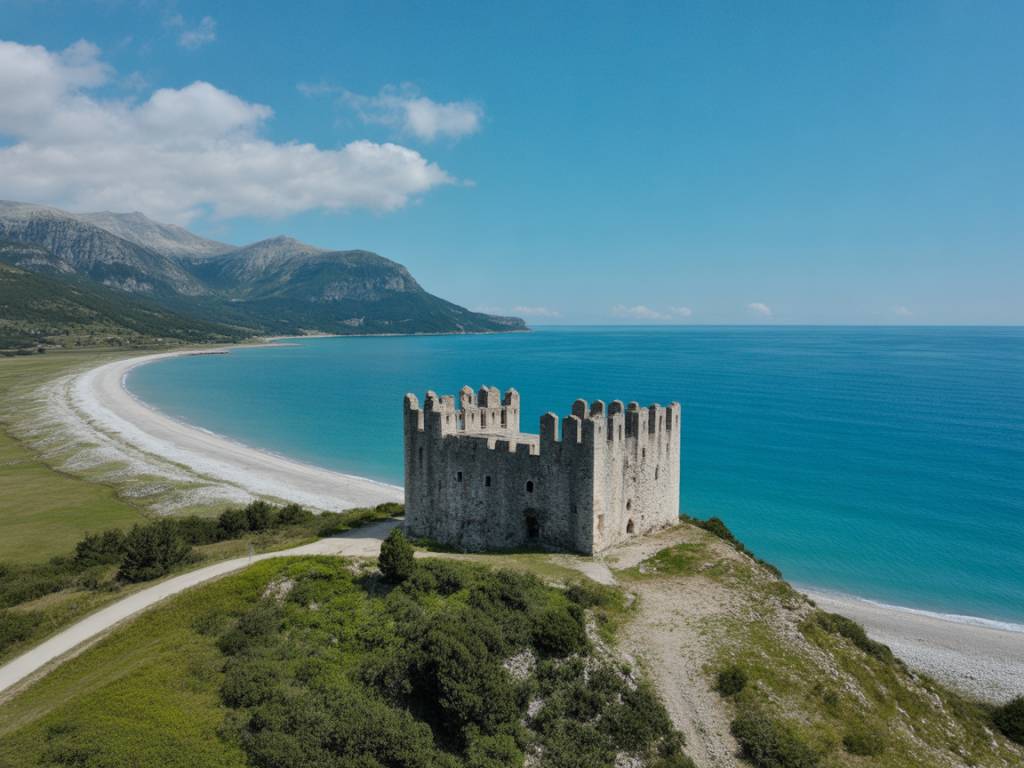
On my way back towards Tirana and, eventually, the UK, I detoured whenever a brown sign promised a castle. Some were modest ruins on lonely hills; others, like Rozafa Castle above Shkodër, offered sweeping views and intricate legends.
At one small fortress, whose name I never managed to pronounce properly, I found the gate open but no ticket booth, no crowds, no signs in English. Only a boy on a bicycle who pointed up the hill and said, “Go, go,” with a grin.
I wandered through broken walls and grass-grown courtyards, alive only with the chirr of insects. Standing in the shade of a crumbling tower, it was easy to imagine how many such places dot this country, waiting quietly while tourists flock elsewhere.
Practical tips for planning an Albania tour from the UK
If my journey has stirred your curiosity, here are some practical thoughts to turn it into your own itinerary.
- Best time to go: Late May to June and September to early October are ideal. Warm sea, pleasant hiking temperatures, and fewer crowds. July and August are hotter and busier, especially on the coast.
- Rental car: Driving gives you the freedom to slip into small towns and out-of-the-way beaches. Roads vary from excellent highways to potholed mountain tracks. Take your time, avoid driving at night, and do not rely solely on your GPS — sometimes the “shortcuts” are only suggestions.
- Money: Albania uses the lek. Many places accept cards, but carry cash for small shops, rural areas and local buses.
- Language: Albanian is unlike anything you know, but you’ll find English widely spoken among younger people and in tourist areas. Smiles and gestures carry you a long way elsewhere.
- Accommodation: Guesthouses are the soul of an Albania trip. Expect simple rooms, generous breakfasts, and hosts who press extra food on you “just in case”. Booking platforms make reserving ahead easy, especially in the Alps where beds can fill in high season.
- Tours vs. independent travel: If you prefer structure, look for small-group tours from the UK that combine Tirana, the Riviera and the Alps over 7–10 days. For more freedom, fly into Tirana, rent a car and stitch your own route together using a handful of anchor points: Tirana, Himarë or Sarandë, Gjirokastër or Berat, Shkodër, Valbona/Theth.
Why Albania is worth discovering now
Travel in Albania has a particular flavour: a mix of raw edges and unexpected tenderness. Roads that crumble at the corners, but waiters who slip an extra dessert onto your table “because you must try this one too”. Ancient fortresses without the polished gloss of mass tourism, and beaches where the loudest sound is still the sea.
For travellers coming from the UK, used to well-oiled tourist machines, it can feel refreshingly human. Things go slightly off-script. Buses are late. Timetables are flexible. Strangers offer you rides. You get lost and find places you never meant to see.
On my last evening, back in Tirana, I sat at a café terrace as the sky shifted from gold to ink-blue. The air was soft and warm. A boy nearby practised tricks on a skateboard, his friends cheering each small victory. Somewhere down the street, someone was playing a folk song on an old accordion. Traffic roared, then ebbed.
I realised, with that familiar ache of departure, that Albania had quietly snagged a corner of my heart. Not with perfection, but with presence: the honesty of its landscapes, the resilience of its people, the way history and everyday life are still interlaced.
If you are sitting in the UK, wondering where your next journey might lead, consider this overlooked piece of Europe. Follow the curve of the Riviera, climb into the Alps, wander through stone cities and forgotten castles. Let Albania surprise you, the way it did me — gently at first, then all at once.