


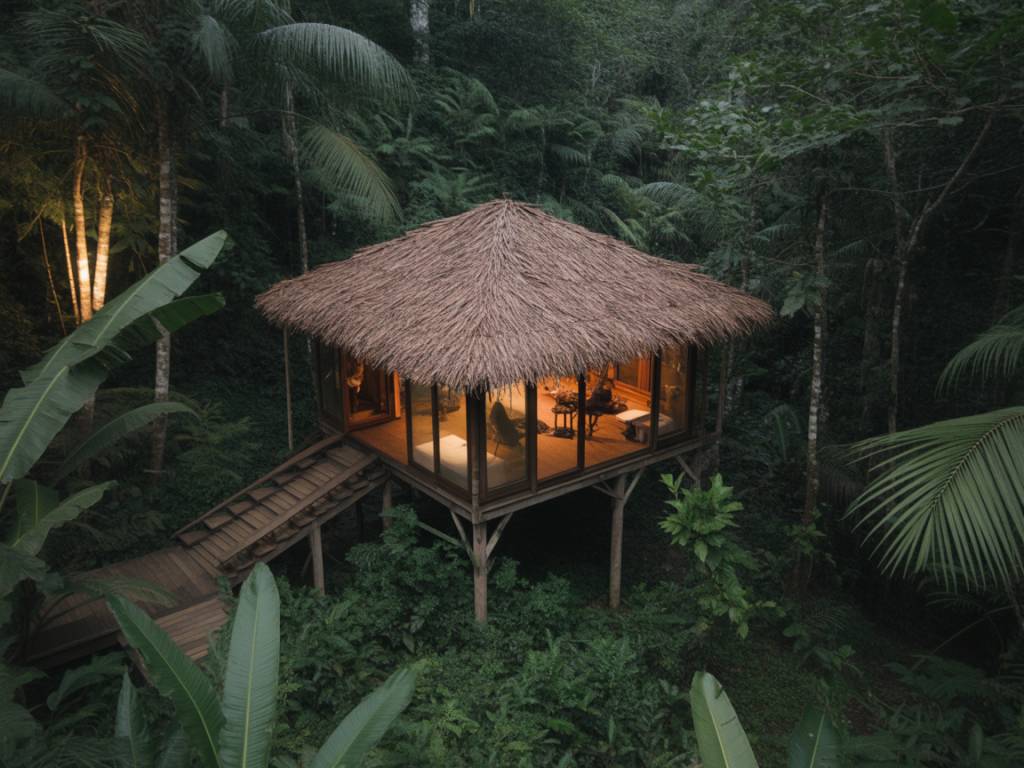
The first thing you notice is the thickness of the air. It feels almost alive: warm, fragrant, humming with invisible wings and distant calls. The boat’s engine cuts, the jungle exhales, and suddenly you’re there — in the heart of the Amazon. Not a line on a map, not a dreamy documentary, but a real, breathing world where you will spend the night, lulled to sleep by the rainforest and woken by a riot of birdsong.
Arriving in the green ocean
Reaching the Amazon is already an adventure.
After a flight to a frontier city — Manaus in Brazil, Iquitos in Peru, Leticia in Colombia or Coca in Ecuador — the final approach is almost always by boat. The river is a broad, brown ribbon, fringed by walls of foliage that seem to lean in, curious about who is arriving this time. Water hyacinths drift by in slow mats. A kingfisher flashes like a drop of blue flame. From the deck, the forest looks solid, impenetrable. It is only when the boat slows and noses into a narrow channel that you realise: this is not a wall, but a labyrinth.
The air changes as you leave the main river. It becomes more intimate, scented with damp earth, crushed leaves, a faint sweetness of orchids you can’t see but somehow feel. Somewhere, a howler monkey starts its guttural roar — a sound that seems more volcano than animal. If you’ve ever wondered what “primeval” sounds like, here is your answer.
By the time you reach your jungle lodge or simple camp, the sun is dropping low, turning the river to molten copper. This is when it hits you: tonight, these trees are your roof, this soft, dense darkness your only curtain.
Where you actually sleep in the Amazon
The idea of sleeping in the world’s largest rainforest can sound both thrilling and vaguely terrifying. Tarantulas? Jaguars? A thousand things that buzz in the night?
In reality, your sleeping arrangements can be as close to (or far from) “survival mode” as you like. Here are the most common ways travellers spend the night in the Amazon:
- Eco-lodges on stilts – These are the most popular option and a gentle way to meet the jungle. Think simple wooden bungalows, raised above the forest floor on stilts, with mosquito nets draped over comfortable beds. At night, the hum of the ceiling fan blends with the murmur of insects outside. Showers are usually cold but blissful, and electricity tends to be limited to a few hours in the evening.
- Rustic river cabins – Often found along smaller tributaries, these are a little more bare-bones, with open windows (covered in mesh), shared facilities and the river as your soundtrack. They feel wonderfully remote — the kind of place where the night sky looks close enough to touch.
- Hammocks under a shelter – For the more adventurous, some tours offer nights in traditional hammocks, strung in a communal shelter with a thatched roof. Everyone sways gently together like a human mobile. You slide into your hammock, close the mosquito net around you, and accept that the forest is very much your neighbour.
- Deep jungle camping – With a skilled guide, you can push further inside the forest and sleep in a simple camp. A tarp, a hammock, the firelight licking at the darkness… this is as raw and immersive as it gets, best suited to those who are comfortable with minimal comforts and maximum sounds.
Whether you choose an eco-lodge with soft sheets or a hammock and a headlamp, one thing remains the same: there are no thick walls to separate you from the living chorus outside. The forest is never really “out there” — it’s around you, above you, breathing with you.
Nightfall: when the forest turns the volume up
Dusk in the Amazon is not a gentle fade to black. It’s a transformation.
As the last smear of orange slips behind the canopy, something shifts. The day voices — the chatter of parrots, the busy hum of bees — begin to quiet. In their place arrive the ones who own the darkness.
Frogs take over first. Tiny, invisible, they produce a staggering range of sounds: sharp clicks, steady beeps, croaks that sound like old doors opening and closing in the distance. Crickets add a continuous, silvery thread. Somewhere nearby, a branch snaps under the cautious step of something unseen. Overhead, a nightjar gives a long, descending whistle, like a sigh released into the trees.
In your room or hammock, everything feels just a little closer. The mesh of the mosquito net turns into your friendly shield, a delicate fortress between you and the outside universe.
You lie down and your senses sharpen. The smell of the wooden walls, warm from the day’s heat. The faint musk of damp soil after a brief rain. The coolness that slips in from the river, carrying the distant laughter of other travellers, the low murmur of guides exchanging stories in Portuguese or Spanish.
If the clouds part, the moon tints the canopy silver. If it rains — and chances are, it will, at least for a short burst — the sound is almost hypnotic. Rain on palm leaves is unlike any other rain: heavier, more layered, like thousands of tiny drums all playing at once. It passes almost as quickly as it arrived, leaving behind a deeper, wetter silence and the sweet, green smell of rinsed foliage.
There’s a moment, sometime in the depth of the night, when you wake for no reason. The darkness feels thick, but not unfriendly. It’s just that the forest has a presence. It’s not quiet, not in the usual sense — yet the steady percussion of insect wings and drip-drops from leaves feels oddly comforting. The city’s sharp noises are gone; in their place is a wild, endless hush that happens to be full of sound.
The symphony at sunrise
Then comes the hour you’ll remember long after your skin has forgotten the humid air: the moment the birds take over.
It starts before sunrise. A single, curious whistle. A faraway hoot. Then, as the world goes from black to blue-grey, someone seems to give a signal, and suddenly the trees are an orchestra pit.
The howler monkeys, never shy, often take the opening solo. Their roar is low, echoing, primal — as if the forest itself has cleared its throat. They call from treetops invisible in the fog, their cries bouncing over the river and folding back into the canopy.
Next come the parrots. Green, yellow, scarlet, flying in tight pairs that squabble cheerfully as they cross the growing light. Their calls are not particularly musical, if we’re honest — more like animated gossip shouted across a street — but they stitch energy into the morning.
Within minutes, the layers build:
- The clear, bell-like notes of tanagers and flycatchers, threading bright strands through the air.
- The repetitive, rising whistles of unseen forest birds, each species with its own tempo and range.
- The chattering of macaws in distant trees, punctuating the soundscape like exclamation marks.
- The soft flap of wings close by as hummingbirds dart between flowers, too quick for your sleepy eyes.
You lie in your bed or sway gently in your hammock, half-awake, the mosquito net a delicate veil between you and the spectacle. Pale light seeps through the gaps in the walls or from beneath the thatched roof. The air is still cool — the only time of day when the humidity feels tender rather than heavy.
A breeze stirs the curtains. The smell of woodsmoke from the kitchen drifts in, promising strong coffee and fried plantains. Somewhere, a boat engine starts in the distance, a small reminder that humans are part of this world too, even if the forest generously allows them only a supporting role in the morning performance.
As the sun finally pushes a golden edge over the treetops, the birds begin to thin their chorus. Their calls don’t stop, but they soften, making space for the daytime insects and the daily business of the rainforest. You get up, slip your feet onto the cool wooden boards, and realise you are stepping into a day that began long before you opened your eyes.
Where to go for an Amazon jungle stay
The Amazon is not one place, but a vast region spanning nine countries. Your experience of sleeping in the rainforest will vary depending on where you choose to go. A few popular starting points:
- Brazil – Manaus & the Rio Negro
From Manaus, you can reach a range of jungle lodges along the Rio Negro. The blackwater rivers here have fewer mosquitoes (a small blessing), and many lodges are on stilts or floating platforms. You’ll find options from simple to quite comfortable, with canoe trips at sunrise and night outings to spot caimans. - Peru – Iquitos & Puerto Maldonado
Around Iquitos, lodges are often only accessible by boat, which adds to the sense of remoteness. Near Puerto Maldonado, in the southern Amazon, eco-lodges line riverbanks and oxbow lakes, with good chances to see macaws, giant river otters and monkeys during your stay. - Ecuador – Yasuni & Cuyabeno
Here, community-run lodges immerse you in both the rainforest and local Indigenous cultures. Many offer early-morning birdwatching towers, giving you a front-row seat to that famous dawn symphony, high above the canopy. - Colombia – Leticia & the tri-border region
From Leticia, you can explore the Amazon where Colombia, Brazil and Peru meet. Simple lodges and homestays along the river give a gentle, authentic glimpse into daily life in the jungle, with nights spent under corrugated roofs and bright stars.
Wherever you go, look for lodges that prioritise sustainability and support local communities — it’s a small but meaningful way to give back to the forest that’s hosting your dreams.
Practical tips for your rainforest nights
Sleeping in the Amazon can be magical, but it’s still a wild environment. A few practical touches will make your nights more comfortable:
- Pack light, breathable clothing – Long sleeves and long trousers in thin, quick-dry fabrics are your best allies against mosquitoes. Neutral colours (greens, browns, beige) help you blend in and attract fewer insects.
- Bring a good headlamp – Electricity is often limited, and you’ll be grateful for hands-free light during night walks, late bathroom runs or rummaging in your bag after dark.
- Use insect repellent wisely – Follow your guide’s advice and wear repellent on exposed skin, especially at dusk and dawn. In some sensitive areas, you might be asked to avoid spraying directly near water.
- Don’t underestimate earplugs (or embrace the noise) – The jungle is loud at night. Many travellers find the sounds soothing, but if you’re a light sleeper, a pair of earplugs can help you drift off, especially on your first night.
- Dry bags and zip-locks are your friends – Humidity is relentless. Keep electronics and important documents in waterproof bags, and accept that your clothes may never feel completely dry until you leave.
- Follow lodge instructions – Sleep under your mosquito net, shake out shoes before putting them on, and avoid leaving food in your room at night. The smallest ants have the strongest opinions about crumbs.
Staying safe and respectful
The Amazon is extraordinary, but it’s not a theme park. Safety and respect go hand in hand here.
Always go with experienced, licensed guides — ideally locals who know the forest as intimately as a childhood home. They’ll read the subtle signs you won’t notice: the scent of rain coming, the alarm call of a bird, the faint track of a passing tapir.
Listen to their advice, especially at night. Stay on paths, use your flashlight, and don’t wander alone into the forest after dark, even if you’re just chasing a better view of the stars.
Respect for the environment matters, too. Take nothing but photos (and memories), leave nothing but footprints — and even those, as light as possible. Many lodges already follow strict rules about waste and water use; joining in those efforts is part of the experience.
Why these nights stay with you
There is a particular silence that settles over you once you’ve slept in the Amazon. Not the outer kind — the forest is never actually quiet — but an inner one. Something about lying there, your breath matched to the slow breathing of trees, rearranges your sense of scale.
You realise how small humans are in this immense green web, and strangely, that doesn’t feel frightening. It feels grounding. Comforting, even. Life goes on here, with or without our watchful eyes, in a complexity we barely understand.
Later, back in the city, a car horn might sound almost vulgar. Your bedroom walls might feel too thick, your window too well-sealed. Part of you will miss the ridiculous chorus of frogs arguing all night, the first rough roar of a howler monkey in the violet pre-dawn, the delicate tap of rain on palm fronds above your head.
And when a bird calls outside your apartment window — a humble pigeon, perhaps, or a blackbird with a simple song — you’ll remember those mornings when the sky turned from ink to gold while hundreds of unseen wings stirred above you. The Amazon will feel both very far away and oddly close, like a dream you didn’t quite wake up from.
Sleeping in the rainforest and waking up to a symphony of birds is not just another holiday experience. It’s an invitation to share, for a brief time, the rhythm of a world that has been singing long before us and will, hopefully, keep singing long after. If you have the chance to answer that invitation, step into the boat, follow the river, and let the forest tuck you in for the night.