


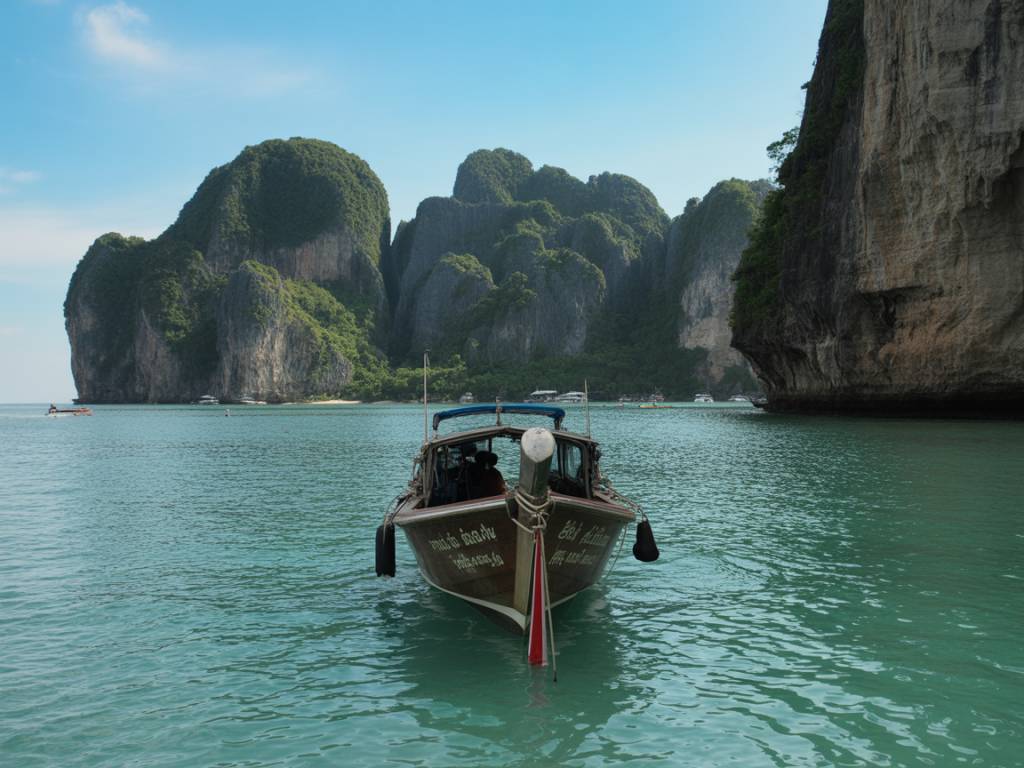
The longtail engine coughs to life at dawn, the air still cool and laced with salt. Ahead, the Andaman stretches silver and unbroken — and for a few precious minutes, Phi Phi feels exactly like the postcard. Then, by 11:00, the same bay is ringed with boats, the water churned white, and the silence is gone. If you’ve ever come back from a day trip Krabi to Phi Phi feeling like you spent more time queuing than swimming, you’re not alone. But the quiet coves are still out there. You just need to know how to reach them.
Why day trips Krabi to Phi Phi feel so crowded — and what actually drives it
Phi Phi Don and Phi Phi Leh together receive well over a million visitors a year, and the vast majority arrive in the same four-hour window: late morning to mid-afternoon. The reason is structural. Most group tours from Krabi depart between 09:00 and 10:30, covering the same circuit — Maya Bay, Pileh Lagoon, Viking Cave, Monkey Beach — in the same order. By the time the third boat of the day drops anchor, the « hidden paradise » of the brochure is anything but.
Three variables control how crowded your experience feels:
- Timing: arriving at famous spots before 09:30 or after 14:30 cuts the crowd by more than half.
- Route order: reversing the standard itinerary puts you at each landmark just as the tour groups leave.
- Vessel type: a private longtail gives you the flexibility to linger or move on — no group consensus required.
Shift even one of these and Phi Phi starts to sound different: fewer engines, more birdsong, the soft lap of water against limestone.
Choosing the right boat for your day trip from Krabi to Phi Phi
Your boat choice will shape the entire day more decisively than any single beach on your itinerary.
Group speedboat tours
The classic option, advertised on every wall in Ao Nang and Krabi Town. A typical full-day package costs around 1,200–1,800 THB per person (roughly £27–£40), includes snorkelling gear and lunch, and covers five or six stops in around seven hours. These tours make sense if you’re short on time, travelling solo, or want a structured, hassle-free day. The trade-off: you share your boat with 20–40 strangers, and your schedule is fixed the moment you book.
Private longtail boat
A private longtail chartered from Phi Phi’s Tonsai Pier costs around 1,500–2,500 THB for a half day, split between your group. For couples or small groups of three or four, the price difference versus a group tour becomes negligible — and the experience is incomparable. You sit low on the water, the hull humming beneath you, and you go where you decide. No schedules, no headcount, no loudspeaker announcing the next stop.
There are two practical approaches for a day trip from Krabi to Phi Phi using a longtail:
- Direct from Ao Nang or Railay: A longtail can take you straight to Phi Phi’s outer bays without stopping at Tonsai Pier. Journey time is longer (roughly 1.5–2 hours each way) and sea conditions matter, but the approach through open water is spectacular.
- Ferry to Tonsai, then hire locally: Take the 08:00 or 08:30 ferry from Krabi Town Pier (around 350–450 THB), arrive by 09:30, and hire a longtail captain directly on the pier. This is often the most flexible option — you can negotiate your own route over a hand-drawn map spread across the captain’s knee.
When to go: the golden hours of the day trip Krabi to Phi Phi
Timing is the single most powerful tool you have. Maya Bay, Pileh Lagoon and Monkey Beach are quietest before 09:30 and after 14:00. The crowd peaks sharply between 10:00 and 13:30 — that’s when the bulk of group tours arrive simultaneously.
The early morning window
Catch the first ferry out of Krabi (departures from 08:00) and have a longtail ready to leave Tonsai the moment you step off the boat. By 09:15 you can be gliding into Pileh Lagoon with perhaps two or three other boats instead of twenty. The light at this hour is extraordinary — low, amber, slanting across the cliff faces. Even Maya Bay, which can feel like a theme park by noon, is genuinely beautiful in the early quiet.
The late afternoon window
Most group tours clear Phi Phi by 14:30 to make the return crossing in time. If you can extend your day — or consider an overnight stay — the late afternoon is a revelation. Snorkel spots that were cloudy with churned-up sand settle back to crystal clarity. Smaller coves catch the honeyed light of the descending sun. Some longtail captains who do sunset runs charge a premium, but the experience is worth it.
How to rethink your route beyond the standard itinerary
The standard circuit exists because it works — Maya Bay, Viking Cave and Pileh are genuinely stunning. But treating them as brief chapters rather than destinations changes the whole rhythm of the day.
A more peaceful route might look like this:
- Arrive early and head straight to Maya Bay or Pileh Lagoon first (check current park entry rules — Maya Bay has timed entry and a 200 THB fee).
- Spend 30–40 minutes, then move on before the main flotilla arrives.
- Ask your captain to take you to smaller, unnamed coves as the morning builds.
- Save snorkelling for late morning when the crowds have concentrated at the famous spots — the fish don’t move, but the boats do.
- Circle back to quieter beaches in the early afternoon as tour groups begin heading home.
The most important question you can ask your longtail captain before you depart is not « Can we go to Maya Bay? » It’s: « Where do you go when you want to avoid the other boats? » Watch their expression change. Locals know pockets that never appear on any tour brochure.
Quiet coves and hidden corners worth seeking out
Few of Phi Phi’s truly calm spots have names you’ll find pinned on Google Maps — that obscurity is precisely what keeps them peaceful. Here are the areas most likely to reward patience and a good captain.
Around Phi Phi Leh
- The inner walls of Pileh Lagoon: Rather than anchoring in the open centre alongside every other vessel, ask your captain to edge along the limestone perimeter. Small, shallow pools form natural enclosures where the water is calmer and the colour shifts from turquoise to deep green. Almost nobody lingers here.
- Snorkel sites off the main channels: The coral patches that captains favour aren’t always photogenic — rocky, uneven, occasionally murky with fish activity — which is exactly why the tour groups skip them. Reef fish density here is often higher than at the « official » snorkel stops.
Around Phi Phi Don
- Long Beach (Hat Yao): Walk or boat beyond the main drop-off point and the crowds thin rapidly. Outside peak season (May–October), you can find a generous curve of sand with barely another soul on it.
- Laem Tong (northern tip): The atmosphere here is slower, more family-oriented, and the beach stretches far enough that space is rarely an issue. It’s a 15-minute longtail ride from Tonsai — far enough to feel like a different island entirely.
Between Phi Phi and Bamboo Island
- Small rocky islets: Several unnamed formations sit between the main islands, offering nothing more than a sliver of sand, deep clear water, and an overwhelming sense of being genuinely away. Ask your captain to linger here rather than rushing to the next famous stop — these are the moments most people miss.
Practical tips to make your day trip Krabi to Phi Phi count
- Book your outbound ferry in advance during high season (November–April) — the 08:00 departure sells out quickly.
- Bring cash in Thai Baht for park entry fees, longtail hire and any local food on Phi Phi Don. Card machines are unreliable on the pier.
- Pack reef-safe sunscreen — standard sunscreen containing oxybenzone is banned in the national marine park and harmful to the coral you’re there to see.
- Go mid-week if possible: weekends and Thai public holidays see noticeably higher boat traffic across the entire archipelago.
- Travel light: a small dry bag, snorkelling mask and fins (hire on Tonsai if needed, around 100 THB), water, and a simple lunch is all you need. Less luggage means more freedom.
Reading the sea: tides and conditions on a Krabi to Phi Phi day trip
The Andaman Sea between Krabi and Phi Phi is generally calm from November to April, with visibility often exceeding 20 metres underwater. From May onwards, the southwest monsoon builds swell and reduces visibility significantly. Many longtail boats stop operating the outer routes during the wettest months (June–August), and some tours are suspended entirely.
Even within good weather windows, tides matter. Low tide exposes sandbars and can strand boats in shallow lagoons; high tide makes the famous sea caves accessible and fills the rock pools with vivid marine life. Ask your captain the night before — or on the morning of departure — what the tidal picture looks like. A good captain plans their route around it automatically. That local knowledge is part of what you’re paying for.
The day trip from Krabi to Phi Phi will always attract crowds — the islands are too extraordinary for that to change. But with the right timing, the right boat, and the right questions asked before you cast off, the quieter version of Phi Phi is still absolutely within reach. Seek the edges. Trust your captain. Let the schedule breathe.