



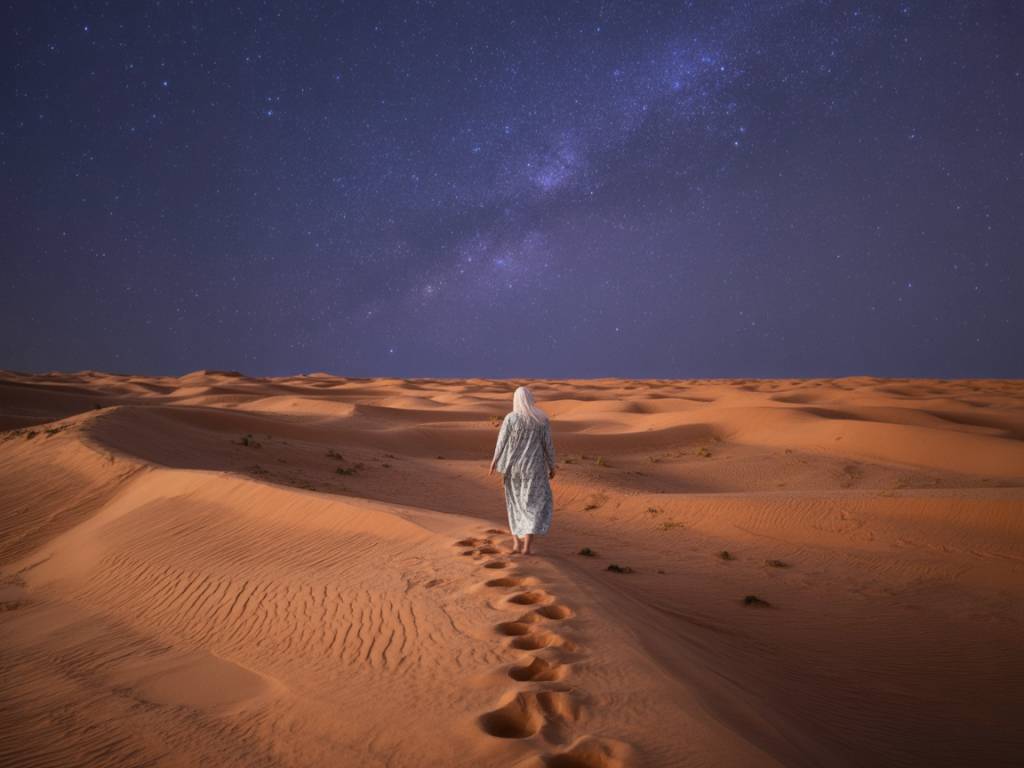
There is a particular moment at the edge of the Sahara when the ocean seems unreal. The taste of salt on your lips, the crash of the Atlantic swell, the long curve of Agadir’s bay — all of it feels like a distant dream once you’re sitting on a dune, watching the sun sink into an ocean of sand instead of water.
This journey, from Agadir’s surf-brushed promenade to a night under a canopy of Saharan stars, is not just a change of landscape. It’s a slow shedding of noise, colour and speed, until only the essentials remain: sky, sand, wind… and you.
From Agadir’s Atlantic breeze to the first breath of desert
Agadir wakes up to the smell of the sea. Early in the morning, before the cafés fill and the promenade gets busy, the city is all soft pastels and low voices. Fishermen are already back from the ocean, their boats resting like colourful commas along the shore. Somewhere, a surfboard waxes squeaks against fiberglass; nearby, someone grills the first sardines of the day.
I had grown used to that soundtrack — the hush of waves, the low rumble of traffic, the murmur of people strolling along the corniche. So when I climbed into the 4×4 that would take me from Agadir to the desert, it felt as if I were changing channels entirely.
The road eastward leaves the coast almost timidly. Buildings thin out, palms replace apartment blocks, and the air grows drier with every kilometre. The blue of the Atlantic behind you fades; in front of you, the Anti-Atlas mountains rise like a quiet promise.
We passed fields of argan trees twisting their way out of rocky soil, their silhouettes almost human at sunset. Women sat in the shade, cracking argan nuts with a rhythm learned over generations. Occasionally, a goat would appear improbably high up in a tree, reminding me that Morocco always has one more scene ready to surprise you.
By the time we stopped in the walled town of Taroudant for mint tea, I could already feel it: the city hum of Agadir had stayed somewhere behind us, muffled by distance and dust. Ahead, the desert was still hours away, but it had begun to write itself into the light. The sky looked a little bigger. The horizon, a little emptier.
The long approach: where the Sahara begins before the sand
People often imagine the Sahara as an endless field of golden dunes. In reality, it introduces itself slowly. Before the postcard image of rolling sand, it comes as stone, gravel, dry riverbeds and a palette of browns you don’t even realize you can distinguish until you’re in the middle of them.
As we drove deeper inland, the landscape stretched. Villages grew smaller and farther apart. The Anti-Atlas faded into plateaus, and the road ran straight for long, meditative stretches. Occasionally, a lone palm tree would stand in the middle of nowhere, as if someone had planted it there purely for effect.
Somewhere after Taliouine — saffron country, its fields resting under the watchful gaze of the mountains — conversations in the car grew softer. It’s difficult to keep talking when the windows are full of so much emptiness. The desert seems to ask for silence long before you see a single dune.
We reached the last real outpost — a small town whose name I almost immediately forgot, but whose dusty main street and sleepy cafés remain vivid in my mind. From there, the asphalt narrowed, then surrendered. The 4×4 dipped off the road and into the realm of tracks: faint lines in stone, as if previous travellers had softly underlined the earth for us.
The first dunes appeared almost shyly on the horizon. Pale, low, hesitant. Then, little by little, the sand gathered courage, climbing higher, turning deeper gold. The light became syrupy, thickening into that particular late-afternoon glow that seems made specifically for the Sahara.
By the time we reached the camp, the sun had already started its slow descent, pulling shadows like long ribbons across the sand.
Arriving in camp: when time changes texture
The desert camp was a small cluster of tents nestled between dunes, its colours almost blending into the sand. There were no fences, no walls, nothing to separate us from the landscape — only fabric, rope, and a few wooden poles holding the scene together.
As I stepped out of the 4×4, the first thing I noticed was the silence. Not the polite quiet of a library or the muffled hum of a late-night street, but a wide, generous silence that seemed to wrap around you. The kind in which you can hear your own footsteps on the sand, the rustle of your clothing, your own breath.
Then the second thing: the softness underfoot. Agadir’s beach sand is already pleasant, but Sahara sand is something else entirely — finer, almost silky, slipping between your toes with a kind of mischievous ease. Walking felt like learning to move again, slowly, deliberately.
Inside the main tent, carpets spilled across the floor in a riot of reds and oranges. Cushions gathered in corners the way people do. The air smelled of mint, wood smoke and the faint trace of spices from the tagine that had been simmering since before our arrival.
Our host, Ahmed, welcomed us with a smile I suspect he reserves for travellers meeting the desert for the first time. Strong tea was poured from high above the glasses, foam rising like a little golden wave in each one.
“Tonight,” he said, “you will sleep with the stars as neighbours.”
He was not exaggerating.
Climbing dunes and chasing the last light
There is a universal rule in the desert: if you want to understand it, you have to climb at least one dune. So, before dinner, we set out for the highest one near the camp, its crest cutting the sky with an almost unreal precision.
The climb looked deceptively simple. From below, the dune rose like a smooth, gentle wave. But with each step, my feet sank back a little, as if the sand were laughing softly at my efforts. It’s an oddly intimate struggle: just you, gravity and a mountain of grains too small to see individually, yet strong enough together to make you work for every metre.
Halfway up, I turned around, breathless. The camp had shrunk into a tiny island of rugs and tents. The plateau surrounding us stretched in muted shades of beige and ochre. Behind me, the crest of the dune glowed with the last light of the day, a sharp line between earth and sky.
At the top, we arrived just in time.
The sun, a deep orange coin, hovered for a moment over the horizon. The sand, which had been bright and hot just hours before, now took on softer tones — rose, honey, copper. Shadows lengthened across the ripples, engraving delicate patterns that looked almost like calligraphy.
For a few minutes, everything seemed to pause. Even the wind quieted down, as if the world were holding its breath for the daily performance of light and shadow.
And then, as quickly as someone flicking a switch, it was gone. The sun slipped behind the distant line of dunes, and the temperature dropped in a way Agadir’s mild evenings had never prepared me for. The sky darkened at the edges, turning from cobalt to indigo. In that brief in-between, when the last light still clings to the sand while the first stars pierce through, the Sahara feels like a place between two worlds.
Under a sky full of stories
Night in the desert doesn’t fall; it unfolds.
By the time we made our way back down to camp, the first stars had multiplied into a crowded, flickering tapestry. With almost no light pollution, the sky seemed fuller, denser — a three-dimensional dome sprinkled with so many pinpricks of light that my eyes didn’t know where to rest.
We ate outside, wrapped in blankets, sitting on carpets warmed by the memory of the day’s sun. The tagine arrived bubbling, steam carrying the scent of preserved lemon, cumin and saffron into the cold night air. Somewhere nearby, bread baked under the sand was unearthed, dusted off, torn open, revealing a soft, smoky crumb.
After dinner, the drums appeared.
Ahmed and two of his friends sat down by the fire with instruments that looked as weathered as the dunes themselves. The first rhythm started shyly, then grew as hands found their pace and our feet joined, tapping along almost involuntarily. A simple metal tray became a percussion tool; voices rose in songs that spoke of caravans, oases, long journeys and longer friendships.
Between songs, we stretched out on our backs, eyes turned upward. The Milky Way spilled across the sky in a pale river. Shooting stars sliced briefly through the darkness, gone almost before you could make your wish. Someone pointed out constellations I only half remembered: Orion, Cassiopeia, the Pleiades.
As the night deepened, the cold sharpened too. I wrapped my scarf tighter around my shoulders, fingers curled around a glass of tea that steamed in the chill. It struck me then how far I was — not just in distance from Agadir’s busy seafront, but in sensation. No neon signs, no car horns, no glow from restaurant terraces. Just firelight, drumbeats and the insistent twinkle of an impossible number of stars.
It is in moments like this that travel becomes less about seeing and more about feeling. The desert is the perfect accomplice for this trick. You don’t just observe it; you inhabit it — for a night, at least.
Waking up to a blue and gold world
Even if you are not a morning person, the desert at dawn will try to convert you.
I woke to a pale light slipping under the flap of the tent and the faint clink of teacups being arranged on a tray outside. The air was still cold, but softer than in the middle of the night — a chill with promise rather than bite.
Stepping outside felt like opening a door into another planet. The dunes, which had looked mysterious and almost menacing under the stars, were now brushed in pastel tones. The sky was a clear, endless blue; the sand, a gentle gold. No harsh shadows yet, no glaring heat — just a soft, luminous quiet.
Somewhere in the distance, a camel groaned, perhaps as reluctant to start its day as most of us. The kettle whistled. Somewhere, someone laughed. The world felt small and wide at the same time.
We took a short camel ride as the sun climbed. It’s not the most efficient way to travel, but there is something humbling about moving at that pace, high above the sand, your mount swaying with each step. The camels’ padded feet made almost no sound as they pressed into the dune slopes, leaving those familiar oval prints that feel like a signature.
From a distance, our little line of silhouettes against the rising sun must have looked like a mirage. From where I sat, it felt like slipping briefly into a much older story.
Practical notes: from Agadir’s surfboard to Saharan sand
If you’re tempted to trade a beach towel in Agadir for a desert blanket under the stars, here are a few practical pointers drawn from my own journey.
-
How long to plan
From Agadir, reaching the real Sahara dunes is not a quick detour; it’s a proper escapade. Many organised trips run over 2 to 4 days, often including stops in Taroudant, Taliouine or Ouarzazate on the way. If you have time, choose at least two nights away — one in a midway town, one in the desert — to avoid spending all your time in the car. -
When to go
The most comfortable months are roughly from October to April. Days are pleasantly warm, nights crisp and often cold. In summer, temperatures can become brutal, especially inland — remember that what feels like a perfect beach day in Agadir may translate into scorching heat in the dunes. -
What to pack
Layers are your best friends. Think:- Light, breathable clothing for daytime
- A warm jumper or fleece and a windproof jacket for the night
- A scarf or shemagh to protect you from wind and sand
- Closed shoes for the rocky stretches + sandals for camp
- High SPF sunscreen, sunglasses and a hat (the sun is not shy here)
- A small headlamp — surprisingly useful after dark
-
Choosing a tour
Many agencies in Agadir offer Sahara experiences. Look for:- Small-group or private tours to avoid the “desert theme park” feeling
- Clear information about driving times and overnight stops
- Commitments to fair treatment of staff and animals (camels included)
- Camps that minimise light pollution so you can actually see the stars
-
Health & comfort
The desert is dry, really dry. Drink more water than you think you need, even if you don’t feel sweaty like on the coast. Bring lip balm and a good moisturiser — your skin will thank you. If you’re sensitive to dust, a light mask or scarf over the nose can make a big difference on windier days. -
Photography tips
The best light is early morning and late afternoon, when the dunes cast long, dramatic shadows. For night photography, a tripod (even a small travel one) and a camera that allows manual settings will reveal more stars than your eyes can process. But don’t forget to take a few moments without a lens between you and the sky.
Why this journey stays with you long after the sand is gone
Back in Agadir a few days later, the city felt at once familiar and slightly unreal. The Atlantic rolled in with its steady rhythm; surfers dotted the waves like punctuation marks; cafés filled with the clink of cups and the murmur of conversation. It was comforting, lively, human.
And yet, as I walked along the promenade, my mind kept drifting eastward. To the silence between dunes. To the rough weave of Berber carpets under my fingers. To the moment a shooting star cut across the sky and everyone around the fire fell quiet at the same time, as if we had all thought of the same wish.
What makes the journey from Agadir to the desert so powerful is the contrast. In just a day, you travel from a city defined by its relationship to the ocean — its fish markets, its sea breeze, its broad beach — to a landscape that seems to exist outside of time, where the main actors are wind and light.
One is about movement: waves, surfboards, seaside strolls. The other is about stillness: sand frozen in gentle lines, a moon that seems impossibly bright, sound reduced to its essentials. And somewhere between those two, on the long road that links the Atlantic to the Sahara, you have time to feel every shift.
Will you miss the ocean? Probably. I did. But there is something almost poetic about watching the sun disappear not into water this time, but into a sea of sand, knowing that just a few hundred kilometres away, the Atlantic is performing its own nightly ritual.
If you find yourself in Agadir with a few spare days and a curiosity for wide spaces, follow that pull inland. Let the city’s salt and spray fade behind you. Trade the crash of waves for the whisper of dunes, and the neon of the promenade for the patience of a thousand stars.
You may return with sand in your shoes and a slight chill in your bones from the desert night air. But you’ll also bring back something far less tangible and far more precious: the memory of a silence so vast that, for a little while, it allowed you to hear yourself think.