



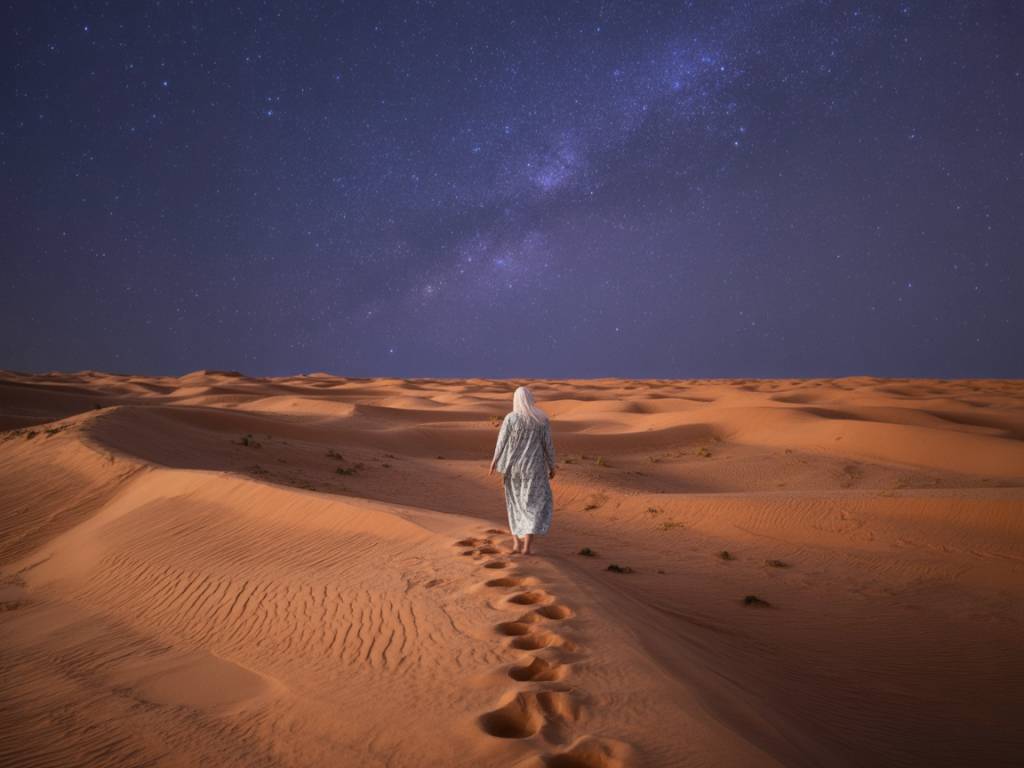
The Atlantic is still in your lungs when the desert begins to call. That is the strange magic of southern Morocco: within a single day, you can trade the salt-heavy breeze of Agadir’s corniche for the bone-dry silence of the Sahara, watching the sun melt not into the ocean, but into a vast, rippling sea of sand. This is the story of that crossing — coast to erg, waves to dunes, noise to stars.
Why the Agadir desert journey is unlike any other in Morocco
Most travellers who attempt a Agadir desert: my journey from atlantic waves to star-filled sahara nights experience are surprised by one thing: it’s not a single dramatic transition. It’s a slow, almost cinematic dissolve. Agadir sits on the Atlantic at roughly 30°N latitude. The nearest true Saharan erg — the rolling golden dunes most people picture — lies between 7 and 9 hours to the south-east, depending on the route and stops. That distance is not an obstacle. It is the journey itself.
What makes this route exceptional compared to the classic Marrakech-to-Merzouga road is its variety. You pass through:
- Argan forest country — UNESCO-listed biosphere reserves where goats genuinely climb trees to reach fruit
- Taroudant, the so-called « little Marrakech », ringed by 16th-century ramparts and filled with souks far calmer than any in the north
- Taliouine, world capital of saffron, where fields blush purple each October and the air carries a faint floral warmth
- The Anti-Atlas, a mineral landscape of folded rock, dry riverbeds and a silence that begins to feel instructive
By the time sand replaces stone under the tyres, you have been prepared — quietly, gradually — to receive it.
Leaving Agadir: the coast fades in the rear-view mirror
Agadir wakes early and gently. Before the promenade fills with sunbathers and the café terraces hum with conversation, the city belongs to its fishermen. Colourful boats rest along the harbour, sardines smoke on open grills, and somewhere nearby a surfboard is being waxed for the first swell of the morning.
Leaving all of that behind — climbing into a 4×4 and turning your back on the Atlantic — takes a conscious decision. The road eastward begins almost apologetically: apartment blocks thin out, replaced by squat palms, then argan trees twisting out of rocky ground like arthritic hands. The air dries noticeably within the first 30 kilometres. Your skin registers it before your mind does.
A first stop in Taroudant (roughly 80 km from Agadir) is more than a practical break. Sipping mint tea poured from a theatrical height inside a riad courtyard, you feel the city hum of Agadir dissolve behind you. The ramparts here are ochre-pink, their crenellations framing a sky that already looks a shade bigger and bluer than on the coast.
The Anti-Atlas and the art of emptiness
Beyond Taroudant, the landscape performs a slow striptease. Colour drains away — greens fade to olive, olive to khaki, khaki to the thousand shades of brown that the desert uses as its vocabulary. Villages appear and disappear like punctuation marks. The road runs straight for stretches that make conversation fall away naturally; there is simply too much emptiness in the windows to keep filling the air with words.
Near Taliouine, at around 1,100 metres altitude, the air carries a coolness that surprises. The saffron fields here produce some of the most prized spice in the world — harvested by hand over just three weeks each autumn, at roughly 150,000 flowers needed per kilogram of spice. Even out of season, there is something meditative about the landscape: low, geometric plots, the mountains watching from above, a quietness that feels deliberate.
Further on, the asphalt eventually narrows, then surrenders entirely. The 4×4 drops off the road and onto faint tracks — ghost lines scored into stone by previous travellers. Here, the first dunes appear on the horizon, pale and low, almost shy. Then, kilometre by kilometre, the sand gathers ambition: it climbs higher, turns a deeper gold, and catches the late-afternoon light in a way that makes the air itself seem to glow.
Arriving at camp: when time slows to a different rhythm
A good desert camp dissolves into its surroundings. Ours was a small cluster of khaïma tents — traditional Berber-style canvas shelters — nestled between two dunes, their colours almost indistinguishable from the sand. No fences. No walls. Just fabric, rope and the horizon stretching away in every direction.
Stepping out of the vehicle, the first sensation is the silence. Not the polite quiet of a hotel corridor, but a wide, enveloping silence in which you can hear your own footsteps, your own breath, the rustle of your jacket sleeve. The second sensation is the sand itself — finer than any beach, almost silky, slipping between your toes with a mischievous ease entirely unlike Agadir’s Atlantic shoreline.
Inside the main tent, carpets rioted in reds and burnt oranges. Cushions gathered in corners. The air carried mint, woodsmoke and the slow perfume of a tagine that had been simmering for hours. Our host, Ahmed, poured tea from high above the glasses — a tradition as much about the foam it creates as about the hospitality it signals.
Practical details worth knowing before you arrive at a desert camp:
- Temperatures drop sharply after sunset — often by 15–20°C — so pack a warm layer even in summer
- Most reputable camps include dinner (usually tagine or mechoui), breakfast and a camel or dune-walking excursion
- Electricity is typically solar-powered; phone signal is absent or minimal — treat it as a feature, not a flaw
- Shared bathroom facilities are standard in mid-range camps; luxury camps offer en-suite desert tents
The dune climb: earning the view
There is an unwritten rule in the Sahara: you must climb at least one dune before sunset. It looks deceptively easy from below — a smooth, elegant wave of sand. In practice, every step sinks back a little, the sand releasing a soft sigh underfoot, as if laughing gently at the effort. It takes roughly 20–30 minutes to reach the crest of a dune 80–100 metres high, and every step is worth it.
At the top, the world reorganises itself. The camp shrinks to a scatter of coloured rugs and tent poles. The plateau spreads in muted ochres and beiges in every direction. And then the light does what Saharan light does best at dusk: it turns syrupy and golden, casting long shadow-ribbons across every ripple in the sand, engraving patterns that resemble calligraphy in a language no one has transcribed.
The sun — a deep copper coin — hovers for a suspended moment, then slips behind the dune line. The temperature drops immediately. The sky at the horizon shifts from amber to rose to indigo. And in that brief in-between, when the last warmth clings to the sand and the first stars pierce through, the Sahara feels genuinely like a threshold between two worlds.
A night under Saharan stars: the real reason to make this journey
Night in the desert does not fall — it unfolds, layer by layer, the way a story does when there is no rush to finish it.
With zero light pollution, the sky above the southern Moroccan Sahara reveals what city life systematically hides. Stars do not appear one by one; they arrive in crowds, filling the dome overhead until the eye genuinely cannot find a patch of black between them. The Milky Way is not a faint smear but a solid, textured band arching from horizon to horizon. On a clear night — and most nights here are clear — you can see satellites drifting in slow, purposeful lines.
We ate outside, wrapped in blankets, tagine steaming into the cold air, the scent of preserved lemon and cumin rising with the smoke from a small fire. Conversation turned naturally philosophical — the desert has a way of asking large questions simply by being so vast and so indifferent to small ones.
Before sleeping, I lay on the sand for a long time, looking up. Back in Agadir, the ocean had been the most humbling thing I knew: its size, its indifference, its ancient rhythms. Here, the sky took over that role entirely.
Both are, in their own way, versions of the same reminder: that the world is enormously bigger and older than anything we carry in our pockets — and that this, far from being frightening, is the most clarifying thought imaginable.
Planning your own Agadir desert trip: key practicalities
If this journey has stirred something in you, here are the essentials to turn it from a dream into a departure date:
- Best season: October to April for mild daytime temperatures (20–28°C); avoid July–August when midday heat exceeds 45°C in the erg
- Route: Agadir → Taroudant → Taliouine → Foum Zguid → Zagora or Erg Chigaga (approx. 7–9 hours driving)
- Transport: A private 4×4 with a local driver-guide is strongly recommended; piste sections are not suitable for standard vehicles
- Duration: Allow a minimum of 3 days from Agadir to properly experience both the crossing and at least one full night in the dunes
- Booking: Choose a camp that is Berber-owned and operated where possible — it keeps revenue local and provides far more authentic storytelling around the fire
The Agadir desert crossing is not the fastest or the most famous route to the Sahara in Morocco. It is, however, one of the most complete: a journey that takes you through every register of the country’s landscape, from Atlantic surf to silent sand, and leaves you, quite simply, changed.