



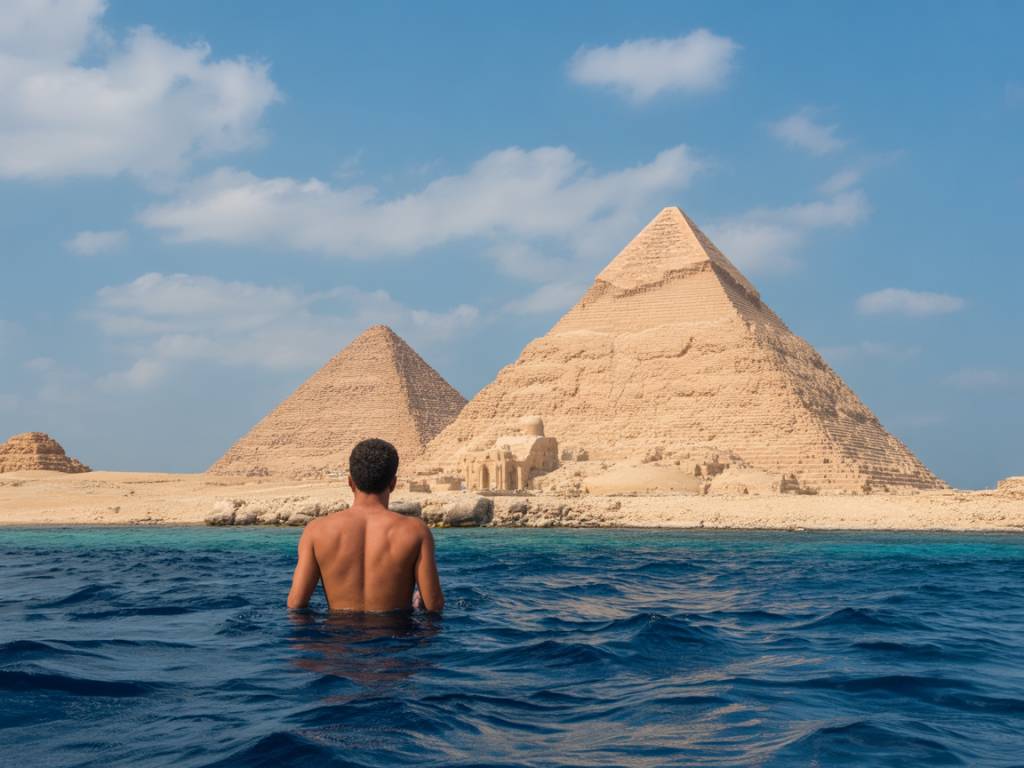
There are journeys that feel like two stories stitched together: the hush of the underwater world and the echo of ancient footsteps in the sand. A trip that starts in Hurghada on Egypt’s Red Sea coast and winds its way to the pyramids and the Nile is exactly that kind of tale — coral gardens and camel tracks, sunken reefs and hieroglyphs bathed in golden light.
If you’re dreaming of Egypt but can’t choose between a beach holiday and a classic cultural itinerary, the good news is: you don’t have to. You can drift with parrotfish in the morning, then gaze at the last surviving Wonder of the Ancient World a couple of days later. Here’s how to weave Hurghada, the Red Sea reefs and a Nile adventure into one fluid, unforgettable trip.
Why start in Hurghada?
Hurghada has grown from a small fishing village into one of Egypt’s best-known seaside escapes. While some areas feel unapologetically resort-like, the real magic lies just offshore, where the water turns from turquoise to inky blue and the reef drops into another universe.
It’s an easy gateway, too. Hurghada has an international airport with direct flights from many European cities. Within an hour of landing, the desert heat wraps around you, the horizon shimmers, and the sea stretches out, impossibly flat and inviting.
What makes it such a perfect starting point for a combined Red Sea–Nile trip?
- Accessibility: Direct flights and a compact airport mean quick transfers to your hotel.
- Warm-up phase: A few days of beach, snorkeling and slow sunsets help you ease into Egypt’s rhythm before the busier days of sightseeing.
- Good onward connections: From Hurghada you can reach Luxor by road, opening the door to the Nile and the temples of Upper Egypt.
On my first morning in Hurghada, I woke to the faint clang of boat masts and the muffled laughter of divers at the marina. The sun was barely up, but the light was already sharp, tracing a glittering path across the water. It’s the kind of place that urges you to put your phone away and simply watch the colors change.
Red Sea reefs: snorkeling, diving & simple sea days
The Red Sea is famed among divers for a reason. Warm, clear, and sheltered by the long, narrow shape of the sea itself, it offers visibility that can reach 30 meters on a good day. Even if you’ve never worn a mask and fins before, Hurghada makes it blissfully easy to try.
Snorkeling for everyone
You don’t need a PADI card to be dazzled here. Many hotels have jetties leading straight to the reef edge, but the most spectacular sites are usually reached by boat. A typical snorkeling trip from Hurghada includes:
- Two or three reef stops, where you slip into water the color of blown glass.
- Lunch on board — often simple grilled fish, rice and salads fragrant with lemon and cumin.
- Long, lazy passages between stops, where you can nap in the shade, the boat rocking gently.
Under the surface, it’s like entering a slow-motion kaleidoscope: purple fan corals swaying, clownfish hovering fiercely over anemones, the quick flash of a blue-spotted stingray melting into the sand. If you stay still, you can hear the reef crackle and pop — tiny shrimp and living coral going about their secret business.
Diving: for the curious and the committed
If you’re a certified diver, Hurghada is a tempting base, with dozens of local dive centers and easy access to celebrated sites like Giftun Island or the wreck of the El Mina. New to diving? Many centers offer:
- Introductory dives in shallow, calm spots with an instructor by your side.
- Open Water courses over three to four days, combining pool skills, theory and open-sea dives.
There’s a moment on a Red Sea dive when the noise of the boat fades above you and the only sounds are your bubbles and your own breathing. The world compresses to a sphere of blue, and a curious butterflyfish comes close enough that you can see its tiny, intelligent eye. It’s as close as many of us will ever come to visiting another planet.
Not a water person? Try the desert.
If the idea of being at sea all day doesn’t appeal, Hurghada also serves as a springboard into the Eastern Desert. Late afternoon is the best time, when the heat softens and the mountains turn from dusty beige to deep mauve.
Desert excursions often include:
- A bumpy 4×4 ride across gravel plains streaked with old camel tracks.
- A stop in a Bedouin settlement, where you might be offered mint tea as children peek around doorways.
- A short camel ride — more sway than gallop — with the smell of leather and dust in the air.
As night falls, the sky over the desert sharpens into a spill of stars that city eyes have almost forgotten. Somewhere in the distance, a generator hums, but above you the Milky Way seems close enough to touch.
From coral to columns: reaching the Nile from Hurghada
After a few days on the coast, many travellers feel the pull of the Nile. This ribbon of green cutting through the desert has nourished Egypt for millennia, and its banks are lined with some of the world’s most storied archaeological sites.
The easiest way to transition from reef to ruins is by road from Hurghada to Luxor. It’s not a short drive — around four hours, depending on stops and traffic — but it’s fascinating. The Red Sea mountains fall away, the landscape flattens, and slowly, fields of sugarcane and palm groves appear as you approach the river.
Practical note: It’s best to arrange this transfer with a reputable tour operator or your hotel; they’ll handle permits and timings, and you’ll travel in an air-conditioned vehicle (a blessing in Egypt’s midday sun).
Luxor and Aswan: the heart of your Nile adventure
If Hurghada is about lightness — salt on the skin, hair stiff from the sea — Luxor feels heavier with history. The air is thicker, tinged with diesel fumes from the corniche and the sweeter scent of ripe dates in the markets.
Luxor: an open-air museum
On the East Bank of the Nile, the Temple of Karnak stands like an enormous stone forest. Walking through its hypostyle hall, you pass between giant sandstone columns banded with faded hieroglyphs. Birds nest in their cracks, and the sunlight pouring through creates stripes of gold and shadow.
Further along the river, Luxor Temple glows warm and honeyed at dusk. I still remember sitting on one of the low walls as the call to prayer drifted over the city, the obelisk’s silhouette slicing into a mauve sky, and thinking: people have watched day end from these stones for more than three thousand years.
Cross the river by boat or car to reach the West Bank, where the Valley of the Kings hides in hills the color of baked clay. Here, tombs slip into the earth like secrets. Inside, the air is cool and faintly dusty, and the colors — lapis-blue ceilings sprinkled with stars, deep ochres and reds — look as if they were painted yesterday.
Aswan: granite, river and slow days
Further south, Aswan feels sleepier, gentler. The Nile broadens here, wrapping around rocky islands where Nubian villages glow in sugar-bright blues and pinks.
Highlights usually include:
- Philae Temple: A graceful complex dedicated to Isis, reached by boat, its colonnades mirrored in the calm water.
- A felucca sail: Late afternoon is perfect, when the sails turn silver against the sky and the water ripples in bands of bronze and teal.
- Nubian villages: Houses painted in bright patterns, the smell of spices and coffee, children calling “welcome” as you pass.
Many travellers also make the early-morning trek to Abu Simbel from Aswan. Standing before the colossal statues of Ramses II, staring out over the desert, you feel very small in the best possible way.
Should you take a Nile cruise?
To link Luxor and Aswan, you can travel by road or train — but a Nile cruise adds a dreamy, old-world layer to your journey. Picture yourself on a wooden deck chair as the river slides past, a glass of mint tea in hand, palm groves rustling and children waving from the banks.
What a typical cruise looks like
Most classic cruises last three to four nights and include:
- Cabins with private bathrooms and large windows overlooking the river.
- Full-board meals, often a generous buffet of Egyptian and international dishes.
- Guided stops at key sites such as Edfu, Kom Ombo and various West Bank tombs.
The pace is blissfully unhurried. Mornings are usually devoted to excursions before the heat peaks; afternoons are for sailing, naps, or simply watching life unfold on the banks: women washing clothes by the water, a boy herding goats, the call of a distant train echoing over the fields.
If you prefer something more intimate and traditional, some operators offer dahabiya cruises — smaller, elegant sailboats with fewer passengers and a softer, almost whisper-quiet glide along the Nile.
Cairo & the pyramids: closing the loop
For many, Egypt isn’t “complete” without seeing the pyramids of Giza, and rightly so. Standing at the edge of Cairo’s sprawl, they rise from the desert in clean, sharp angles, impossibly geometric against the chaos of the modern city at their feet.
First sight of the pyramids
Nothing quite prepares you for the scale. Up close, the blocks are taller than you’d imagine, scarred by wind and time. The air is full of fine sand, and camel bells jingle softly as guides offer rides along the plateau.
A good visit usually includes:
- The Great Pyramid of Khufu and the slightly smaller pyramids of Khafre and Menkaure.
- The Great Sphinx, eroded but still enigmatic, staring eternally east.
- A panoramic viewpoint where all three main pyramids line up against the sand, perfect for that wide-angle shot.
Nearby, the Grand Egyptian Museum (GEM), opening in stages, is becoming the new home of treasures from across the country, including many from Tutankhamun’s tomb. It’s a beautiful way to tie together everything you’ve seen in Luxor and along the Nile.
Linking Cairo with Hurghada & Luxor
Depending on flight routes and time, you could:
- Fly into Cairo, spend a couple of days exploring the city and Giza, then fly to Hurghada.
- Or start in Hurghada, travel overland to Luxor, cruise to Aswan, then fly or train up to Cairo at the end.
Both directions work; it’s really a question of whether you prefer to begin with culture and end with the sea, or the other way round.
Suggested itineraries: blending reef and river
To help you imagine your own journey, here are two sample itineraries that combine Hurghada, the Nile and the pyramids.
Option 1: Sea first, history after (10–12 days)
- Days 1–4: Hurghada — Settle in, snorkel or dive, take a desert sunset trip, enjoy quiet evenings by the water.
- Day 5: Hurghada to Luxor — Early road transfer, afternoon visit to Luxor Temple.
- Days 6–8: Nile cruise (Luxor to Aswan) — West Bank visits, Karnak, then slow sailing with stops at Edfu and Kom Ombo.
- Day 9: Aswan — Philae Temple, optional felucca ride, perhaps Abu Simbel if you have the energy.
- Days 10–12: Cairo & Giza — Fly or train to Cairo, visit the pyramids, Sphinx and museum before flying home.
Option 2: Ancient Egypt first, sea as a soft landing (10–12 days)
- Days 1–3: Cairo — Pyramids, museum, and maybe a stroll through Islamic Cairo’s lanes in the evening.
- Day 4: Cairo to Luxor — Flight or train, sunset visit to Luxor Temple.
- Days 5–7: Nile cruise (Luxor to Aswan) — Immerse in temples and river life.
- Day 8: Aswan to Hurghada — Fly via Cairo or transfer to Luxor and travel by road, depending on connections.
- Days 9–12: Hurghada — Let everything sink in as you snorkel, read by the pool, and watch the light dance on the water.
The second option can feel particularly soothing: you tackle the busiest sightseeing at the start, then allow the Red Sea to wash away the dust and intensity of the cities at the end.
Practical tips for a smooth journey
A little preparation goes a long way in Egypt. Here are some details that often make the difference between a good trip and a truly relaxed one.
- When to go: October to April offers milder temperatures, especially for temple visits. Summer can be extremely hot inland, though the Red Sea coast benefits from a breeze.
- What to wear: Light, breathable fabrics, a wide-brimmed hat, sunglasses, and a scarf (useful for sun, dust and occasional mosque visits). Modest attire is appreciated away from resort areas.
- Sun & hydration: The sun can be unforgiving. High-SPF sunscreen, refillable water bottles and electrolyte tablets are your friends.
- Money matters: Cash is still useful for tips, small purchases and markets. ATMs are common in cities and resort areas.
- Local guides: In Luxor, Aswan and Cairo, a knowledgeable, licensed guide transforms stone into stories. Don’t hesitate to ask questions — Egyptians are often wonderfully generous with their knowledge and anecdotes.
- Respect the sites: Avoid touching carvings or leaning on ancient walls, and follow photography rules closely, especially in tombs.
Why this combination stays with you
What lingers after a Hurghada–pyramids–Nile journey isn’t just a checklist of famous sights. It’s the way your senses keep tripping back to small, vivid details: the taste of cardamom in a tiny cup of coffee after a dive; the grain of sandstone under your fingertips at Karnak; the whisper of the Nile against the hull of your boat at night; the way the desert cools so quickly once the sun drops.
There is a quiet joy in knowing that, within a single trip, you’ve floated above coral gardens and stood before monuments carved for pharaohs. One world looked up at you from the sea; another towered over you from the sands.
If Egypt has been calling you — but you couldn’t decide between reef or ruins, beach or river — maybe you don’t need to choose at all. Let Hurghada be your soft landing, the Red Sea your first chapter, and the Nile your ancient, winding epilogue. The story you’ll come home with will be all the richer for it.