



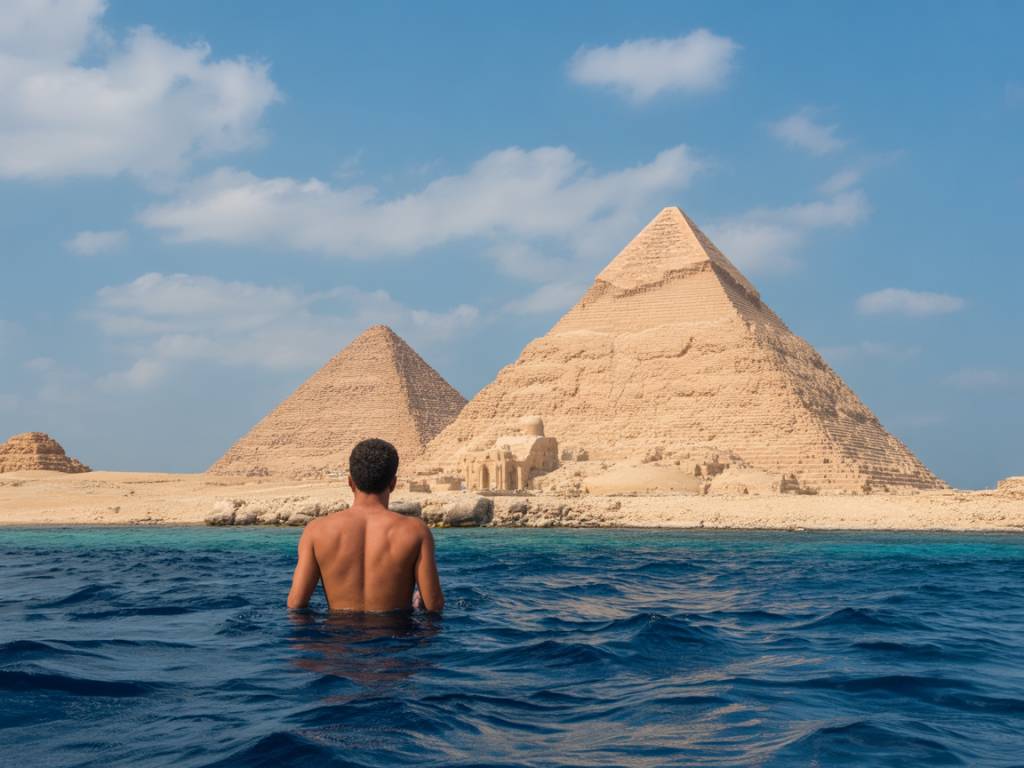
Egypt has always offered two completely different worlds — one submerged in coral and saltwater, the other carved in stone and silence beneath a desert sky. A trip that moves from Hurghada’s Red Sea coastline to the pyramids and the Nile valley is one of the most rewarding combinations in modern travel. You can float above a living reef in the morning and, a few days later, stand at the foot of structures that have outlasted every empire on earth. You don’t choose one Egypt or the other. You take both.
Hurghada Egypt Pyramids: Why This Dual Itinerary Works So Well
Combining Hurghada, Egypt’s pyramids and a Nile adventure into a single trip is easier than most travellers expect. The distances are manageable, the contrast is exhilarating, and the two halves of the journey complement each other in rhythm: the coast gives you rest, the Nile valley gives you depth.
Hurghada is the natural entry point. The city’s international airport receives direct flights from London, Paris, Frankfurt, Warsaw and dozens of other European hubs, often at competitive prices. Within an hour of landing, you’re on the water or beside it — desert heat at your back, the Red Sea shimmering ahead. Spend three to five days here before heading inland, and you’ll arrive at the ancient sites refreshed rather than jet-lagged and overwhelmed.
- Compact airport, fast transfers: Most hotels are 20–40 minutes from the terminal.
- Ideal decompression: A few slow sea days reset your pace before the intensity of sightseeing.
- Practical road link: The Hurghada–Luxor road runs roughly 290 km through the Eastern Desert — about four hours by private transfer — opening a direct gateway to the Nile.
The Red Sea Reefs: What to Expect in and Around Hurghada
The Red Sea is one of the world’s top diving destinations, and for good reason. Water temperatures hover between 22°C and 28°C year-round, visibility regularly reaches 20–30 metres, and the reef ecosystems here are among the most biodiverse outside the Indo-Pacific. Hurghada sits at the northern end of the Egyptian Red Sea coast, making it an accessible base for both casual snorkellers and experienced divers.
Snorkelling: No Certification Required
You don’t need a diving licence to be genuinely dazzled. Most tour operators run daily boat trips from the marina to nearby reef systems, including the protected waters around Giftun Island National Park. A typical half-day trip covers two or three reef stops and usually includes:
- Equipment hire — mask, fins and snorkel vest included in most packages
- Grilled fish or buffet lunch on board
- A guide who points out highlights: moray eels tucked into coral heads, parrotfish scraping algae from the reef, clouds of anthias fish catching the light
Under the surface, the reef crackles with quiet life. Clownfish guard their anemones with surprising ferocity; blue-spotted stingrays drift just above the sandy floor; fan corals pulse softly in the current. First-timers often emerge from the water wide-eyed and already planning a second session.
Diving: From Beginners to Advanced
Hurghada hosts dozens of PADI- and SSI-accredited dive centres, many concentrated around Sigala and the Old Town marina. Certified divers can access sites like the El Mina wreck, Abu Ramada’s coral gardens and the deeper walls around Giftun Island. For those new to the sport, options include:
- Discover Scuba Diving sessions: a half-day experience in shallow, calm water with an instructor, no prior experience needed
- PADI Open Water courses: completed over three to four days, covering theory, pool skills and open-sea dives — a useful way to spend time productively before heading to Luxor
Average visibility at the main sites sits around 20 metres, and most reef dives range from 8 to 18 metres depth — ideal conditions for new divers building confidence.
Beyond the Water: The Eastern Desert
If the sea isn’t calling, Hurghada borders the Eastern Desert, where afternoon light turns the mountains from dusty gold to deep mauve. Desert excursions typically include a 4×4 ride across gravel plains, a stop at a Bedouin settlement with mint tea, and a short camel ride as the sun drops. After dark, well away from the resort strip, the desert sky delivers a density of stars that most European city-dwellers have genuinely never seen.
Hurghada Egypt Pyramids Route: Getting from the Red Sea to the Nile
The transition from coast to culture is one of the great moments of this itinerary. Leaving Hurghada, the road climbs into the Red Sea mountains before descending westward across flat desert scrubland. Around the three-hour mark, the landscape softens almost imperceptibly — scattered palms appear, then sugarcane fields, then the first blue flash of the Nile itself. It feels like an arrival.
The most practical options for this leg of the journey are:
- Private transfer: The most comfortable choice — door-to-door in an air-conditioned vehicle, typically 3.5 to 4.5 hours depending on traffic and checkpoints. Your tour operator handles all permits.
- Shared minibus services: Cheaper but less predictable in timing; best arranged through a reputable local agency rather than street touts.
- Domestic flight (Hurghada–Luxor): Available but adds airport time; worth considering if you’re short on days.
Practical tip: Schedule your transfer for early morning — you’ll arrive in Luxor before the midday heat peaks, and you’ll have the afternoon free to explore at a gentle pace.
Luxor: Temples, Tombs and the Heart of Ancient Egypt
Luxor is sometimes called the world’s greatest open-air museum, and the label is hard to argue with. The city sits on the site of ancient Thebes, Egypt’s imperial capital for much of the New Kingdom period (roughly 1550–1070 BC). The concentration of monuments here is simply unmatched.
East Bank: Living City, Ancient Stones
The Karnak Temple Complex is the largest religious structure ever built. Its hypostyle hall alone contains 134 massive sandstone columns, some reaching 21 metres high, covered in hieroglyphs and relief carvings still faintly coloured after more than 3,000 years. Allow at least two hours; most people leave wishing they’d planned for more.
Luxor Temple, a short walk along the corniche, is best visited at dusk when the floodlights warm the sandstone to amber and the city hums quietly around it. The temple’s avenue of sphinxes, recently excavated and restored, stretches nearly three kilometres toward Karnak.
West Bank: Valley of the Kings and Beyond
Cross the Nile — by local ferry or as part of a guided tour — and you enter a landscape of ochre cliffs and hushed heat. The Valley of the Kings contains 63 known royal tombs, including Tutankhamun’s famously intact burial chamber. Entry tickets typically cover three tombs (Tutankhamun’s requires a separate ticket); arrive early to avoid tour group crowds after 9 am.
Nearby highlights on the West Bank include:
- Hatshepsut’s Mortuary Temple at Deir el-Bahari — a stunning three-tiered structure cut directly into the cliff face
- The Colossi of Memnon — two enormous seated statues that greet you at the road’s edge, free to visit
- Medinet Habu — Ramesses III’s memorial temple, less crowded than Karnak and extraordinarily well preserved
Aswan and the Pyramids: Completing Your Egypt Adventure
Travelling further south from Luxor, Aswan offers a gentler, more intimate pace. The Nile widens here, wrapping around rocky islands where Nubian villages are painted in vivid blues and pinks. Key stops include Philae Temple (dedicated to Isis, reached by short boat ride), the Unfinished Obelisk in the granite quarries — cracked mid-creation and abandoned 3,500 years ago — and a late-afternoon felucca sail, the traditional wooden sailboat, as the light turns bronze on the water.
From Aswan, a day trip to Abu Simbel (280 km south, best reached by early-morning convoy or a short domestic flight) brings you face-to-face with Ramesses II’s colossal rock-cut temples — among the most dramatic sights in all of Egypt.
To complete the classic Hurghada Egypt pyramids itinerary, factor in a night or two in Cairo before or after the Red Sea. The Giza Pyramid Complex — home to the Great Pyramid of Khufu, the only surviving Wonder of the Ancient World — is a 30-minute drive from central Cairo. Pair it with a visit to the Grand Egyptian Museum, opened in stages since 2021 and now housing the world’s largest collection of ancient Egyptian artefacts, including the complete treasures of Tutankhamun’s tomb.
Planning Your Combined Red Sea and Nile Trip
The best time to travel is October through April, when temperatures across Egypt are comfortable for both beach days and sightseeing (25–30°C on the coast, 20–28°C in Luxor and Aswan). Summer months (June–August) bring intense heat in Upper Egypt, sometimes exceeding 45°C inland, though the Red Sea remains popular year-round.
A well-paced itinerary might look like this:
- Days 1–4: Hurghada — snorkelling, a dive course, desert sunset excursion
- Day 5: Transfer by private car to Luxor (morning departure)
- Days 5–7: Luxor — East Bank temples, West Bank tombs, sunset on the corniche
- Days 8–9: Aswan — Philae, felucca, optional Abu Simbel day trip
- Day 10: Fly Cairo — Giza pyramids, Grand Egyptian Museum
- Day 11: Fly home from Cairo
Working with a specialist travel company means logistics — transfers, permits, skip-the-queue tickets and knowledgeable local guides — are handled before you land. What remains is the journey itself: coral gardens one week, thousand-year-old stone the next, and the quiet satisfaction of having seen Egypt in full.