



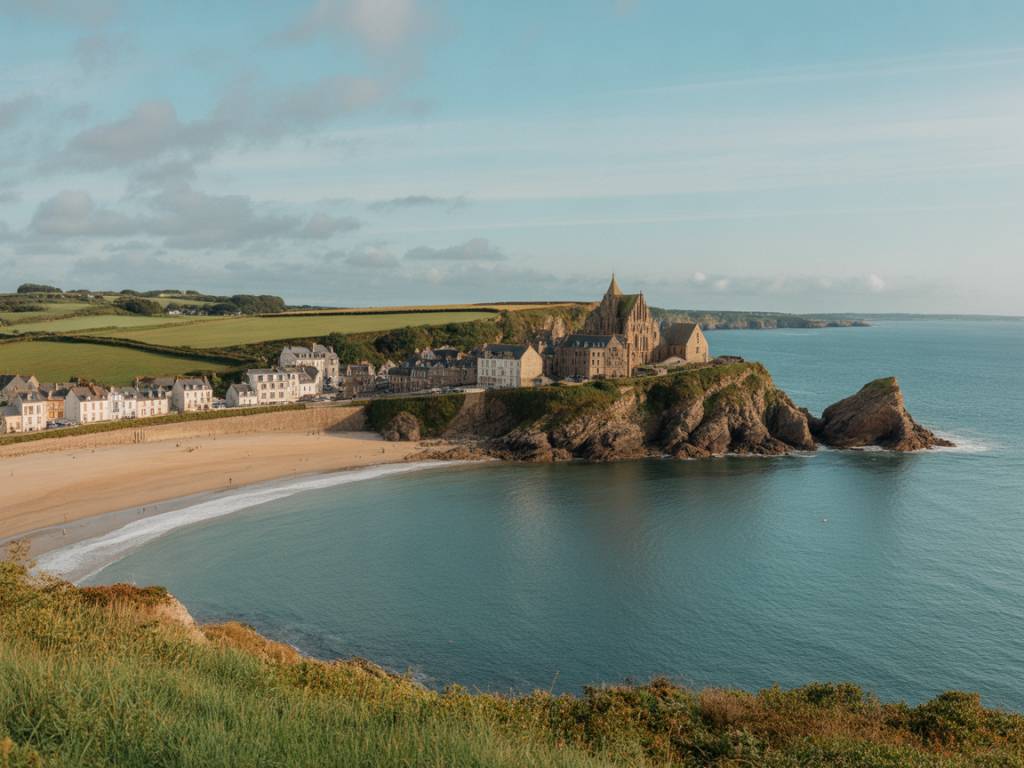
Why Brittany is perfect for a self-drive road trip
Brittany is one of those regions that grabs you quietly and never really lets go. It doesn’t shout like the French Riviera, and it doesn’t try to impress with big-city glamour. Instead, it wins you over with windswept capes, stone villages that smell of butter and salted caramel, and quiet little ports where fishermen still fix their nets as the tide goes out.
It’s also an ideal destination for a self-drive trip on a modest budget. Distances are short, parking is usually free or very cheap outside the big towns, and many of the best experiences don’t cost anything: walking a coastal path, watching the tide race around a lighthouse, picnicking above a hidden cove.
In this guide, I’ll take you through a flexible, budget-friendly road trip itinerary around Brittany’s wild coasts and Celtic heartlands, with plenty of crêpes along the way.
When to go and how long to stay
If you can, aim for late April to June or September. In July and August, Brittany is at its busiest: still beautiful, but campsites and coastal villages fill up, and prices jump. Outside the peak, you’ll find:
I’d recommend at least 7 days for a satisfying loop, and 10–12 days if you like to travel slowly and linger in villages or on beaches. Brittany is deceptively compact, and you won’t spend hours stuck on motorways; instead, expect winding country lanes between hedgerows, and small B-roads that suddenly open onto dramatic sea views.
Starting point: getting to Brittany with or without a car
Most travellers arrive either via Rennes, the regional capital, or by ferry from the UK and Ireland. For a self-drive itinerary, your main options are:
On a budget, the cheapest combination is often a low-cost flight or train to Rennes plus a compact rental car. You don’t need a big vehicle: roads are generally excellent, and smaller cars are easier to park in medieval town centres.
Rennes: a gentle urban start
I like to start in Rennes, to ease into the Breton rhythm. It’s a youthful city, thanks to its universities, but its half-timbered houses and cobbled streets remind you that Brittany has a long memory.
If you arrive early, spend a half-day wandering the old town:
Budget tip: there’s no need to sleep in Rennes if you’re eager to hit the coast. Pick up your rental mid-morning, wander for a couple of hours, then drive out to the sea in the afternoon.
Saint-Malo and the Emerald Coast: corsairs and tidal drama
From Rennes, it’s an easy 1-hour drive to Saint-Malo, the walled corsair city on the Emerald Coast. As you cross the modern causeway, you see the stone ramparts rising from the sea like a fortress from a novel.
Park outside the walls (cheaper and far less stressful), then walk in through one of the old gates. The best things to do inside the old town are free:
If the budget allows, treat yourself to a crêpe and a bowl of cider (bolée de cidre) at a simple crêperie; prices in Saint-Malo are higher than inland, but you can keep costs down by sharing dessert or choosing a simple butter-and-sugar crêpe.
Overnight, consider staying outside the old town for better prices: suburbs like Paramé or nearby villages along the coast offer small B&Bs, Airbnbs and basic hotels.
Cap Fréhel and the Pink Granite Coast: wild cliffs and silent sentinels
From Saint-Malo, follow the coast westwards towards Cap Fréhel, one of the wildest headlands in Brittany. The drive itself is a pleasure: small villages, glimpses of sea through pine trees, and, if you’re lucky, gorse and heather in bloom.
Cap Fréhel is all about the elements. Park at the main lot (a small fee helps maintain the site) and walk paths that skirt purple cliffs dropping into the Atlantic. The wind carries the sound of seabirds, and the lighthouses stand like silent guardians.
From here, you can continue to:
If time allows, drive on to the Pink Granite Coast (Côte de Granit Rose), between Perros-Guirec and Trébeurden. The rock formations here look almost sculpted by hand, huge pink boulders stacked as if a giant had been playing. One of my favourite budget-friendly walks is the path between Ploumanac’h and Perros-Guirec, where:
Stay overnight in a small inland village a few kilometres from the coast to trim your accommodation budget. Often, moving just 10–15 minutes away from the sea can save you a surprising amount.
Into the Celtic heartland: Huelgoat and the Monts d’Arrée
After the coast, I always feel drawn inland to Brittany’s more mystical side. From the Pink Granite Coast or Cap Fréhel area, point the car towards Huelgoat, a quiet town surrounded by forests and boulder-strewn streams.
Here, Brittany feels deeply Celtic and a little mysterious. Walking trails lead from the town into a forest scattered with enormous granite rocks, with names like “The Trembling Rock” and “Devil’s Cave.” There’s no admission charge; you simply follow the paths and let your imagination run wild.
Nearby, the Monts d’Arrée are Brittany’s low, windswept “mountains.” They don’t reach dizzying heights, but the landscapes feel almost moorland-like, with:
This is one of the cheapest areas to stay in Brittany, with simple guesthouses and rural gîtes. It’s also a good region to stock up on supermarket supplies: bread, cheese, fruit, and cider for picnics along your route.
Finistère and the end of the world: Crozon Peninsula and Pointe du Raz
The western tip of Brittany is known as Finistère, “the end of the earth.” It feels like it, in the best possible way. Two spots in particular are perfect for a self-drive adventure: the Crozon Peninsula and Pointe du Raz.
The Crozon Peninsula, south of Brest, is a compact playground of cliffs, beaches and small coves. My favourite loop involves:
Many parking areas here are either free or very low-cost, especially outside July and August, making it easy to hop between viewpoints.
Further south, Pointe du Raz is Brittany’s most famous cliff-edge viewpoint. Yes, it can get busy, and there’s a paid car park, but the feeling of standing at the very edge of mainland France, watching the sea tear past the lighthouses, is unforgettable. Walk beyond the main lookout areas to find quieter spots along the cliffs.
Budget tip: stay in inland towns like Douarnenez or small villages on the way to Quimper. You’ll find more affordable rooms and local crêperies where the menu of the day can be remarkably gentle on the wallet.
Quimper and Locronan: medieval stone and Breton soul
Driving east again, head for Quimper, the cultural heart of Cornouaille, with its elegant gothic cathedral and half-timbered houses leaning over narrow lanes. Quimper has a peaceful, lived-in feel: this isn’t a theme park town but a real place where students and families go about their routines.
Stroll along the Odet River, wander the historic quarter, and if your budget allows, drop into a café for a bowl of cider and a simple crêpe complète (ham, cheese and egg in a buckwheat crêpe).
From Quimper, a short drive takes you to Locronan, a remarkably preserved granite village that seems almost suspended in time. Cobbled streets, slate roofs, and artisan shops line the small square. Locronan is popular, but if you come early in the morning or late in the afternoon, it’s easier to feel its quiet charm.
Parking fees help preserve the village, but otherwise wandering is free. To save money, browse the craft shops with your eyes rather than your card, and keep an eye out for fixed-price menus in simple restaurants rather than the most picturesque terraces directly on the square.
South coast detour: Concarneau, Pont-Aven and the Gulf of Morbihan
If you have extra time, continue along the south coast. This stretch of Brittany has gentler light and more sheltered bays, but it still carries that unmistakable Breton spirit.
Highlights include:
Overnights in this area can be pricier in high season, so once again, look a little inland: small market towns often have budget hotels and family-run guesthouses with breakfast included.
Back to Rennes through the land of standing stones
On your way back towards Rennes, try not to miss Carnac and its mysterious alignments of standing stones. Thousands of megaliths stretch across the fields, older than the pyramids and still only partly understood.
There are both paid and free viewpoints; if you want to keep spending low, you can see many stones from public paths and minor roads. A short drive away, smaller sites like Erdeven or the stone circles near Locmariaquer offer quieter, often cheaper alternatives.
From here, it’s a straightforward drive back to Rennes, with plenty of opportunities to stop in small towns, pick up last-minute jars of salted caramel or Breton biscuits, and slowly say goodbye to the region.
Eating, sleeping and saving: budget tips for Brittany
One of the joys of Brittany is how easy it is to travel well without spending a fortune. A few practical pointers:
For accommodation, I like mixing:
Driving practicalities: parking, roads and rhythm
Driving in Brittany is generally relaxed. Roads are well-maintained, and once you escape the main routes near Rennes or Brest, traffic thins out. To make your self-drive trip smoother:
The pleasure of a Breton road trip is not racing from A to B but drifting between viewpoints, ports and chapels, stopping whenever a tiny side road looks promising. Some of my favourite memories come from wrong turns: an unmarked beach, a village fête, a crêperie with no English menu but a warm welcome.
Let Brittany work its slow magic
What stays with me after each Brittany road trip isn’t just the big postcard moments—the lighthouse at sunset, the dramatic cliffs, the sculpted stones. It’s the smaller, quieter details: the smell of butter in a village square at 8 a.m., the Breton flags snapping in the wind on a fishing boat, the sound of Breton language on a market day, the way the sea seems to change colour every hour.
With a modest budget, a simple car and a rough plan, you can trace your own route through this Celtic peninsula. Follow the wild coasts, linger in stone-built villages, and never say no to another crêpe. Brittany rewards those who take their time—and those who are happy to let the road, and the tide, set the pace.